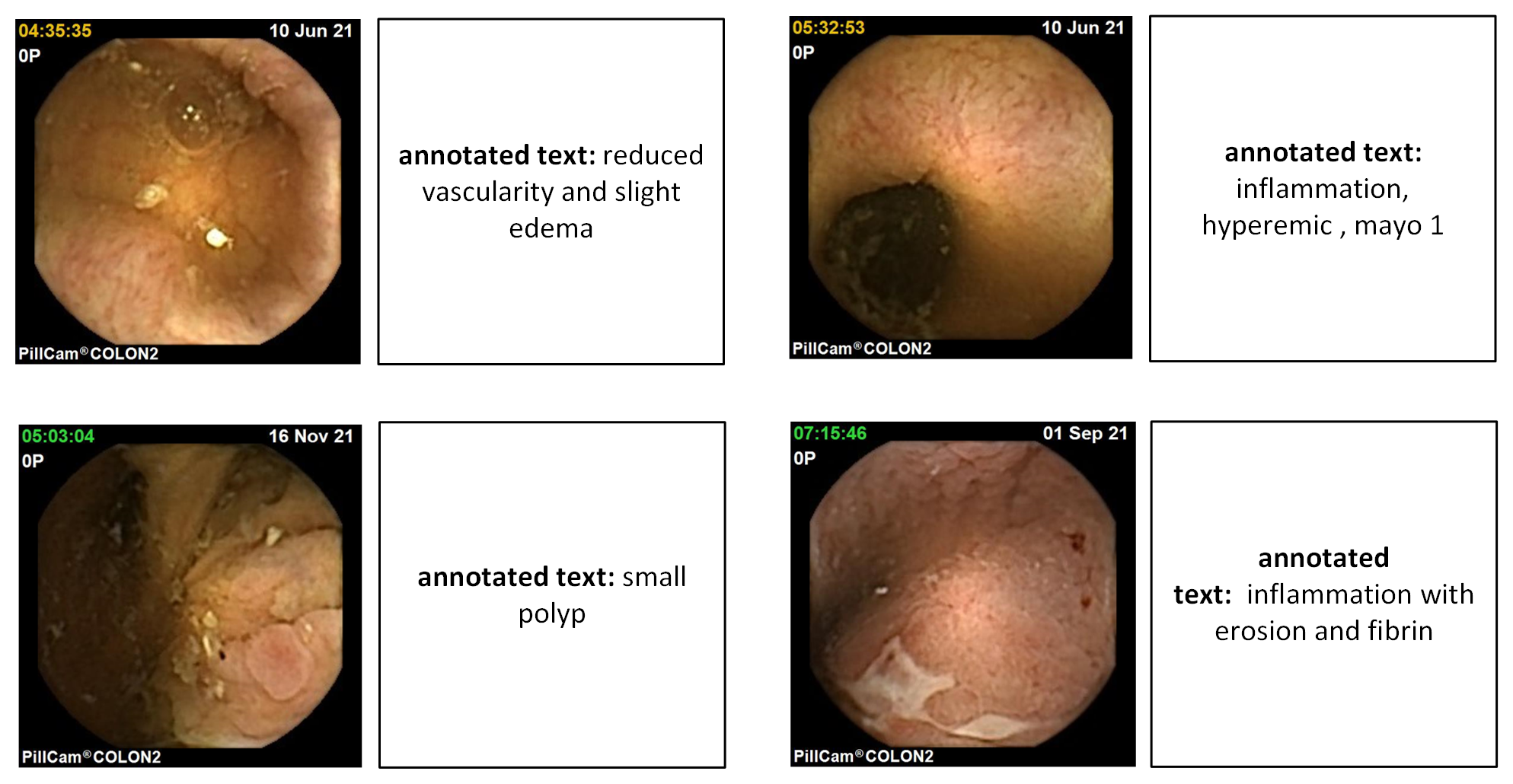
Wireless Capsule Endoscopy (WCE) is a minimally invasive diagnostic tool for examining the gastrointestinal tract, but the interpretation of large amounts of WCE image data demands extensive manual efforts and expert knowledge. Deep learning offers a promising approach to automate WCE data analysis, but training robust models is hindered by the scarcity of large-scale, high-quality labeled data in the WCE domain. This study explores the use of Contrastive Language-Image Pre-training (CLIP), a vision-language model pre-trained on extensive image-text pairs, to address these challenges in deep learning for WCE. We focus on caption retrieval and pathology classification tasks, using the CAPTIV8 dataset, a multi-modal WCE dataset containing image-diagnostic text pairs. After customizing the dataset for deep learning tasks, we conducted experiments comparing CLIP with state-of-the-art vision models. The results demonstrated that CLIP performs better than vision-only models, particularly in small-sample regimes such as one-shot and few-shot setups. By replacing the original CLIP loss with a KL-divergence loss, we further enhanced the model’s ability to handle multiple positive pairs in a mini-batch during the training, to further attune learning for this specific medical domain.
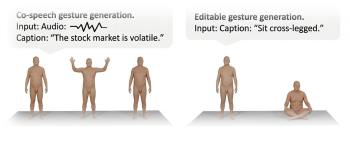
Human motion language models (Human-MLMs) have shown that text, speech, and motion can be brought into a shared generative framework. Most MLMs, however, encode body motion primarily through joint-centric SMPL features defined with respect to a fixed reference pose. While effective, this view compresses rich human movement into a single vocabulary and can under-represent local structures and movement co-dependencies of body part biomechanics. In this paper, we present JaBOR (Joint-aligned Bone Orientation Representation), a hierarchical bone-centric motion representation designed as a general plug-in for Human-MLMs. JaBOR complements conventional joint-based motion features by expressing each bone in a locally rotation-normalized coordinate frame defined by four structurally selected keypoints: Pivot, Free, Axis, and Plane. Combined with compositional body-part tokenization and multi-representation training, JaBOR exposes LLMs to richer motion vocabularies without changing the high-level goal of existing MLM pipelines. We evaluate JaBOR in a preliminary motion tokenization-level study by integrating it into three Human-MLM pipelines: MotionGPT, MotionGPT3, and LoM. On the reported benchmarks, JaBOR improves Fréchet Inception Distance (FID) from 0.232 to 0.211 for MotionGPT and from 0.208 to 0.181 for MotionGPT3, while preserving diversity in two of the three reported settings. These results support the view that bone-based motion representation is a useful complementary signal for motion-language modeling. We position exercise form coaching and broader multimodal motion translation as promising future directions enabled by this representation.
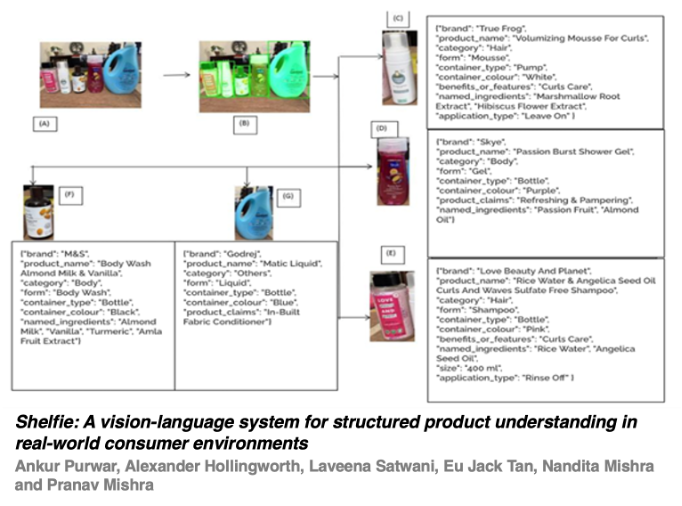
Personalized consumer experiences increasingly depend on understanding actual product usage in everyday settings. We present Shelfie, a consumer-centric vision-language system that extracts structured product metadata from user-submitted images of lifestyle care products arranged in real-world contexts – such as consumer shelves, countertops, and vanity spaces. Unlike conventional systems developed for controlled retail environments and dependent on barcode scanning, Shelfie is intentionally designed to operate effectively in cluttered, unconstrained home settings and is fully barcode-independent. Shelfie integrates object detection, instance segmentation and large language model (LLM)-based reasoning to infer rich metadata for each visible product. This includes product brand, name, category, form, package type, key ingredients, benefits, and size. The Shelfie system is trained and validated on a diverse user-sourced dataset covering personal care to home lifestyle products, demonstrating strong generalization in producing high-accuracy highly structured output across packaging styles and product categories. Shelfie establishes a vision-language foundation for real-world consumer-facing product understanding and discovery systems. It can enable downstream applications such as community-driven recommendation systems, ingredient sensitivity tracking, and indepth consumer behavior analysis all while keeping consumer habits, needs and convenience at the center. By bridging visual input with structured metadata output, Shelfie can enable more informed, personalized decisions through peer-driven insights.

With the rapid progress of multi-modal large language models (mLLMs), there is growing interest in whether such models can act as judges of image quality. A fundamental question exists, however, as to the ability of such models to distinguish between various levels of image quality attributes, such as sharpness and noise. This work represents one of the first systematic investigations of mLLMs as evaluators in classical paired comparison image quality assessment (IQA) experiments. Prior work in mLLM-based vision has focused on captioning or recognition tasks, whereas our study explicitly frames Gemini 2.0 Flash as a proxy subject in psychovisual testing to establish just noticeable differences (JNDs) for sharpness and noise using the Kodak image quality ruler dataset as stimulus. For both sharpness and noise, the magnitudes of JNDs were found to be proportional to the relative quality of the stimulus. Surprisingly, judgments of individual pairs of images were found to be probabilistic rather than absolute, with more uncertainty observed for sharpness discrimination than noise. Prompt engineering is detailed as is the statistical analysis of results. Understanding the extent to which mLLMs can act as reliable perceptual proxies offers transformative implications for automated IQA, dataset labeling, and adaptive imaging pipelines.
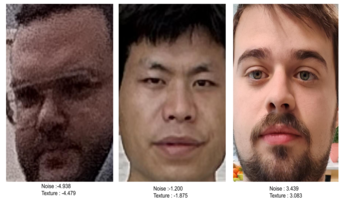
With the growing adoption of multimodal large language models (MLLMs) for image quality assessment, Vision–Language IQA systems such as DeQA-Score have demonstrated a strong correlation with human judgments on natural images. However, current MLLM-based quality predictors primarily provide global image quality scores and therefore lack the ability to quantitatively assess specific perceptual attributes such as noise, texture, contrast, and color factors that are essential for explainability and camera tuning. In this work, we extend DeQA-Score from global Mean Opinion Score (MOS)-based quality prediction to attribute-specific, Just Objectionable Difference (JOD)-based portrait assessment. Our study investigates how a MOS-trained model behaves when exposed to pairwise-annotated data and how lightweight adaptation can achieve perceptual alignment at the attribute level. Using a controlled mannequin dataset, we analyze the model’s baseline behavior under different prompt strategies and spatial input configurations, revealing limited attribute sensitivity. We then apply LoRA fine-tuning on realistic portrait data annotated for texture and noise quality. The adapted model achieves correlations of SRCC = 0.91/0.93 and PLCC =0.91/0.90 with JOD scores for noise and texture, respectively. Subsequent analysis confirms that the vision encoder is the main contributor to perceptual learning. The proposed framework establishes an efficient path for converting global VLM-based Image Quality Assessment (IQA) models into attribute-aware, perceptually aligned assessors for real-world photography.
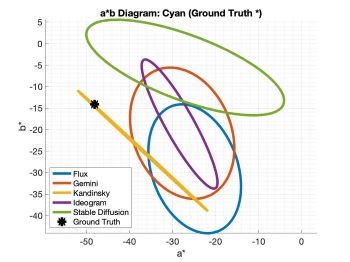
With the proliferation of text-to-image generative AI, understanding the fidelity of their output is critical. While these models can generate visually stunning images, their interpretation of nuanced, subjective concepts like color names remains largely unquantified. This paper introduces a systematic framework to evaluate how accurately leading generative AI models (including Flux, Ideogram, Kandinsky, Gemini and Stable Diffusion) understand and reproduce colors from textual prompts. We prompted these models with both one-word (e.g., ”blue”) and two-word (e.g., ”sky blue”) color names to generate uniform color fields. The resulting images were analyzed by converting them to the perceptually uniform CIE Lab color space. An adaptive k-means clustering algorithm was employed to extract the dominant color, mitigating issues of non-uniformity in the generated images. By calculating the perceptual color difference using CIEDE2000 (ΔE00) and the chromatic distance (Δab) between the AI-generated colors and standardized ground-truth values, we provide a quantitative benchmark of each model’s color accuracy. Our findings reveal that while all models broadly understand the mapping between color names and hue, significant performance variations exist among models, with systematic differences in lightness and chroma reproduction. Per-model analysis reveals a clear hierarchy in chromatic fidelity: Gemini and Flux demonstrate the strongest anchoring, while Kandinsky exhibits striking hue-dependent anisotropy and Stable Diffusion shows the broadest isotropic dispersion. Per-color analysis identifies systematic undersaturation of short-wavelength and high-chroma colors (blue, indigo, magenta) across all models, while warm colors (red, orange, yellow) are generally better grounded. We highlight that results vary significantly across random seeds for the same prompt and model, and that lexical specificity generally—but not universally—improves chromatic grounding. This work provides a robust methodology for auditing and improving color fidelity in future generative models.
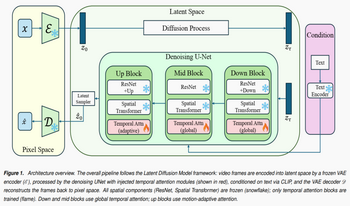
We present a motion-adaptive temporal attention mechanism for parameter-efficient video generation built upon frozen Stable Diffusion models. Rather than treating all video content uniformly, our method dynamically adjusts temporal attention receptive fields based on estimated motion content: high-motion sequences attend locally across frames to preserve rapidly changing details, while low-motion sequences attend globally to enforce scene consistency. We inject lightweight temporal attention modules into all UNet transformer blocks via a cascaded strategy—global attention in down-sampling and middle blocks for semantic stabilization, motion-adaptive attention in up-sampling blocks for fine-grained refinement. Combined with temporally correlated noise initialization and motion-aware gating, the system adds only 25.8M trainable parameters (2.9% of the base UNet) while achieving competitive results on WebVid validation when trained on 100K videos. We demonstrate that the standard denoising objective alone provides sufficient implicit temporal regularization, outperforming approaches that add explicit temporal consistency losses. Our ablation studies reveal a clear trade-off between noise correlation and motion amplitude, providing a practical inference-time control for diverse generation behaviors.
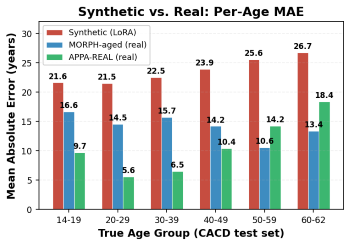
Facial age estimation systems require diverse training data across all age groups, yet existing datasets exhibit significant demographic biases and pose privacy concerns. We evaluate whether Low-Rank Adaptation (LoRA) fine-tuned text-to-image diffusion models can generate age-specific synthetic faces suitable for training age estimation models. We train 199 age-gender specific LoRA models on a standardized compilation of five established datasets and generate a balanced synthetic dataset of 29,850 images. Across four prediction paradigms and seven test datasets, models trained on synthetic data produce substantially higher error than real-data baselines on all regression tasks. Perage analysis on held-out data shows uniformly high MAE (21–27 years) even for age groups with abundant training data, indicating that data imbalance is not the primary cause. Relabeling the synthetic images with an external age estimator reduces MAE by roughly half, confirming that the generated faces are visually plausible but do not depict the intended target ages. These findings indicate that standard LoRA cannot reliably encode age as a semantic attribute in diffusion model outputs.