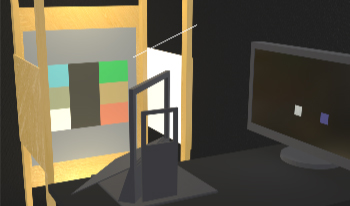
The perceived color in optical see-through augmented reality (AR) deviates from physical additivity, but the driving factors and their interactions remain poorly understood. The authors conducted four psychophysical color-matching experiments manipulating seven factors including stimulus size, viewing mode, starting point, and presentation medium. A generalized linear mixed-effects model analysis of the coordinate-wise differences in CIECAM16-UCS space revealed stimulus size as the strongest predictor. Reducing the stimulus size—which increases the relative area of the chromatic surround—produced shifts that tended to be opposite to the background chromaticity, consistent with classical simultaneous contrast. The viewing mode and presentation medium had small effects concentrated on the blue–yellow axis, whereas the starting point produced a small procedural shift across all axes. The linear additive model showed limitations: nonlinear deviations were confined to specific targets where chromatic induction was strongest. These findings suggest that background discounting in AR largely reflects low-level simultaneous contrast, complementing higher-level accounts such as layer scissioning.
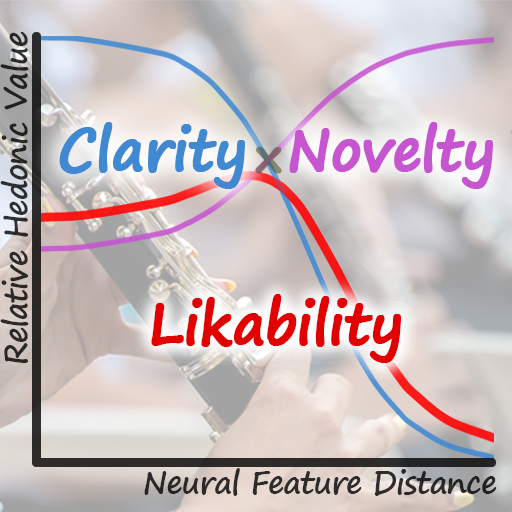
This study investigates the factors underlying the Wundt curve in graphic design based on Berlyne’s reinterpretation. The paper presents the results of a psychophysical study in which Likability, Novelty, and Clarity of manipulated flyer design images were assessed by means of magnitude estimation. To connect these measurements into a unified framework, the authors propose a model based on the (inverted U-shaped) Wundt curve, where Likability exhibits a nonmonotonic trend and is determined by the product of perceived Clarity and Novelty. To test this hypothesis, subjective evaluations were conducted using flyer design images systematically varied along a feature-distance axis defined relative to typical designs, where the feature distance was computed using EfficientNet-B0. The results showed a Wundt-curve-shaped trend with a moderate fit to the idealized curve. The findings indicate that the product of Clarity and Novelty plays an important role in determining Likability and provide a basis for refining Wundt-curve-based models.