
Margin-based Face Recognition (FR) has achieved remarkable performance by learning discriminative feature representations that ensure high intra-class compactness and inter-class separability. While most state-of-the-art methods focus on developing margin-based loss functions, improving model generalization performance is equally critical, especially under open-set conditions where test identities are absent from training data. Recent developments in learning algorithms have highlighted the sharpness of the loss surface as a key factor in reducing the generalization gap. Building on this, Sharpness-Aware Minimization (SAM) introduced a weight perturbation step to enhance generalization performance, with Adaptive Adversarial Cross-Entropy (AACE) further refining SAM by modifying the perturbation step. Inspired by those researches, we propose FlatFace, a novel training framework for face recognition that adopts weight perturbation into the training process. FlatFace consists of two key steps: the perturbation step, which perturbs model parameters in both the feature extractor and class weights toward the worst-case scenario, and the weight updating step, which uses the loss gradient at the perturbed feature extractor and class weights to update the parameters. By guiding the model toward flatter minima, Flat-Face improves generalization performance and accuracy, particularly for open-set face recognition tasks. Empirical experiments confirm its effectiveness, demonstrating reduced generalization gaps and enhanced overall performance.
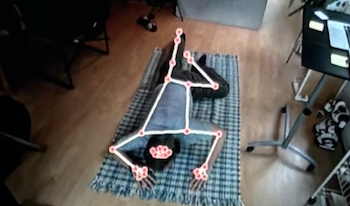
Human gestures in the real-world are complex, ranging from sign language, to full body motion, to extremely dynamic poses such as crawling and dancing. This study examines a set of multimodal sensory fusion methods to support the real-time operation and training without the need for wearable equipment. We articulate the gesture tracking sensor modality based on the gesture tracking types, accuracy, detection latency, distance, key point requirements, and accuracy with LiDAR, webcam and inertial measurement unit (IMU) for complex gesture recognition. We applied the methodology to applications of gait detection and tracking in a high altitude, sign language detection, and background noise removal in a crewed space. Our experiments show that the usability of the multimodal interfaces can be tested in a simulated environment and measured with instruments objectively.
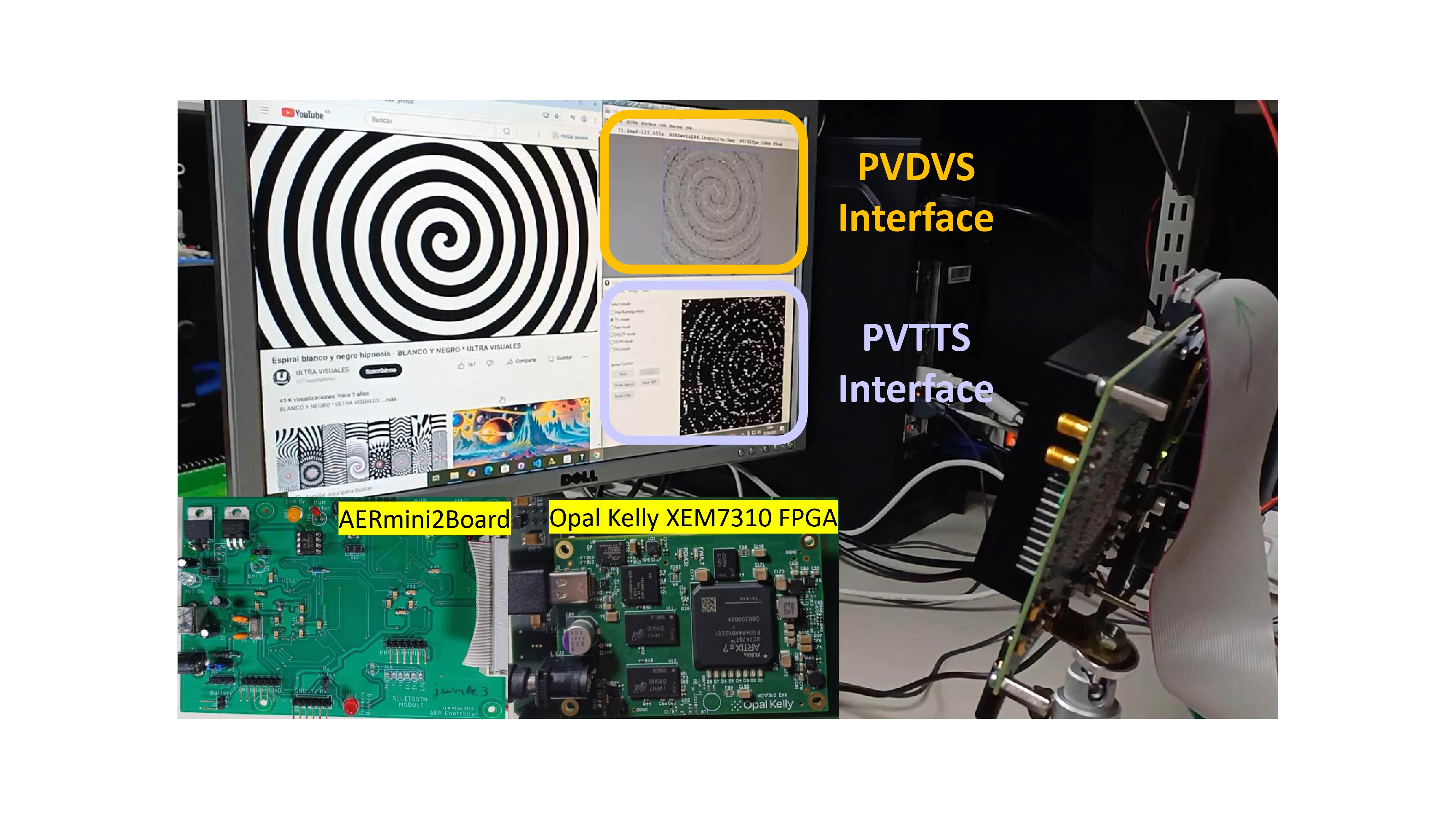
Asynchronous Time-Based Image Sensors (ATIS) jointly perform event-driven temporal contrast detection and local exposure measurement, reducing throughput by reporting only relevant information with high temporal resolution. We introduce PVATIS, a new pixel front-end that replaces the conventional pair of reverse-biased photodiodes plus a logarithmic receptor with a single diode operated in photovoltaic mode. In open-circuit, this diode simultaneously serves as the photodetector and provides logarithmic compression in a self-biased configuration. The approach directly tackles pixel-level constraints, such as pixel pitch, noise, and energy, while trading off bandwidth due to increased integrated capacitance. PVATIS is therefore a strong candidate for high-resolution, HDR, low-noise, and energy-efficient operation, particularly suitable for 3D-stacked implementations and moderate-speed imaging.
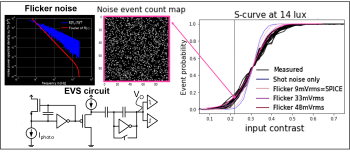
Event-based vision sensors (EVS) are gaining interest in applications requiring low latency, high dynamic range, and energy-efficient imaging, such as image deblurring, object detection for autonomous vehicles, and AR/VR glasses. Unlike conventional frame-based sensors, their performance is highly sensitive to device-level noise processes, especially in low-light scenes. In previous work, we proposed a framework for pixel-wise parameter estimation for EVS characterization. We introduced a physics-based model and a shot noise model and validated them on a typical pixel setup. However, that model did not explicitly account for flicker noise, despite its being one of the major noise sources in modern CMOS technologies—a key factor behind pixel-to-pixel variability and spurious "noisy pixels," whose strength depends strongly on the technology. In this paper, we introduce a dedicated flicker-noise component into the previously developed EVS simulator. We calibrated the circuit flicker noise model using circuit-level simulations and sensor measurements, achieving an error margin of less than 20%. The resulting model reproduces EVS circuit noise statistics and generates realistic synthetic event streams. The results indicated that flicker noise was larger than the value expected from SPICE simulation by a factor of five. Our work enables circuit-level trade-off studies and offers intuitive noise visualizations for both hardware designers and algorithm developers to assess algorithmic impact.
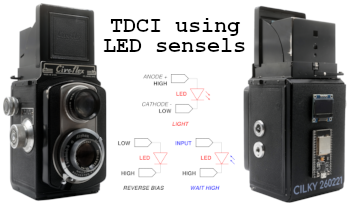
Time domain continuous imaging (TDCI) centers on the capture and representation of time-varying image data not as a series of frames, but as a compressed continuous waveform per pixel. A high-dynamic-range (HDR) image can be computationally synthesized from TDCI data to represent any virtual exposure interval covered by the waveforms, thus allowing both exposure start time and shutter speed to be selected arbitrarily after capture, which also enables extraction of video with arbitrary frame rate and shutter angle. Unfortunately, conventional sensors cannot directly implement TDCI capture, so earlier work focused on postprocessing conventional sensor output to approximate TDCI streams. The current work describes the first direct implementation of TDCI sensing. The sensors discussed here are not image sensor chips, but prototype equivalent circuitry and control logic as low pixel count board-level sensor modules constructed using commodity components. A LED is used to implement each sensel, and each is sampled asynchronously independent of all other sensels by reverse biasing the LED to charge its inherent capacitance and then timing how long the photocurrent takes to reach a fixed threshold voltage. These open source LED-based TDCI sensor modules are used to construct stand-alone TDCI cameras, allowing performance measurements, tweaking of the control logic, and empirically verifying that true TDCI sensing is practical.
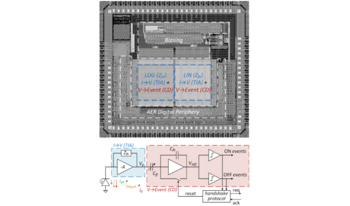
Event-driven imaging enables low-latency, high-throughput sensing by reporting only temporal changes in a scene. A comparison of event-based and frame-based cameras under I/O-limited conditions shows that event-driven sensors achieve higher effective frame rates and lower latency in sparse scenes, while approaching frame-based limits as scene activity increases. Extending event-driven sensing to infrared (IR) wavelengths is challenged by elevated dark current and background-induced photocurrent. The limitations of conventional logarithmic (LOG) front-ends are analyzed, and performance is compared with a linear (LIN) front-end exhibiting stable conversion gain under high background conditions. Results indicate improved contrast sensitivity and minimum event temperature at high background, with LOG and LIN architectures each providing advantages over different background regimes.
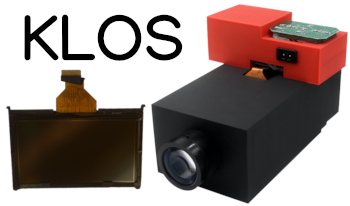
Compressed sensing allows reconstruction of complete image data from sparse sampling. In sequential single-sensel imaging, a spatial light modulator is used to select groups of pixel locations whose transmitted or reflected light is measured by a single detector. This function is commonly implemented using a digital micromirror device (DMD), but DMDs are relatively small and expensive. This work investigates the use of a transmissive liquid crystal display (LCD) panel as a lower-cost, larger-format alternative. The Kentucky LCD One Sensel (KLOS) prototype repurposes a consumer projector LCD and its control electronics, combining them with custom 3D-printed camera components, a projector lens, and a Fresnel lens. Preliminary testing demonstrates that both random and deterministic binary patterns can be used successfully, confirming the feasibility of the concept. However, serious practical limitations were observed, including sample-rate limitations imposed by HDMI control, synchronization lag, limited LCD contrast, and strong sensitivity to panel-to-sensor alignment.

Absorption imaging using CMOS image sensors (CISs) enables non-invasive and non-destructive visualization and measurement of fluid concentration distributions. However, achieving high signal-to-noise ratio (SNR) under high illumination is challenging because large full well capacity (FWC) reduces conversion gain (CG) and increases input-referred noise. This work proposes a two-stage lateral overflow integration capacitor (LOFIC) CIS featuring dual pixel reset voltage (Dual VR) operation with an in-column programmable gain amplifier (PGA) and multi-sampling to suppress input-referred noise electron. The fabricated 140 × 140-pixel CIS achieved 130 dB dynamic range and 72.8 dB maximum SNR at 1000 fps. Imaging experiments demonstrated clear visualization of minute concentration variations, indicating suitability for high-speed absorption applications including in-chamber gas monitoring.
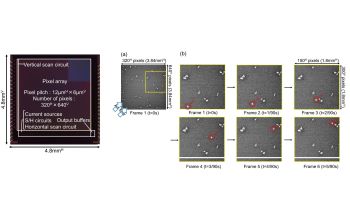
This paper presents a newly developed global shutter proximity capacitance CMOS image sensor capable of high-speed and high-precision capacitance detection using noise cancellation technology. The chip was fabricated by a 0.18 μm CMOS process technology. It integrates high-density Si trench capacitors as in-pixel memories and features a 320H × 640V pixel array with a pixel size of 12 μmH × 6 μmV. Experimental results demonstrate that the sensor successfully captures distortion-free capacitance images and simultaneously achieves a high frame rate of 90 fps and a high detection precision of 12 zF. Furthermore, a burst mode utilizing in-pixel memories enables continuous signal acquisition, achieving an unprecedented detection speed of 167 kfps. The developed sensor is expected to significantly improve inspection efficiency in diverse fields, including manufacturing and life sciences.
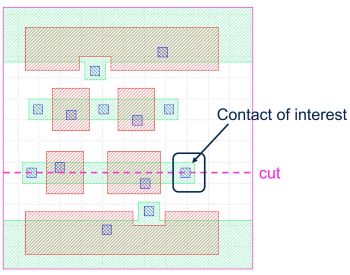
Large-format CMOS image sensors used in cinematography are highly susceptible to systematic defect mechanisms that are difficult to detect using conventional wafer-probe testing. This work presents a wafer-level diagnostic methodology that leverages each die’s captured image to generate defect and noise maps, which are then reassembled into full-wafer mosaics. This approach exposes spatially correlated defect patterns that electrical probing alone cannot reveal, including wafer-edge localized pixel failures and color-filter non-uniformities. By correlating defect signatures with pixel-level layout coordinates, we traced paired-pixel artifacts to excessive oxide formation at shared inter-pixel vias. Physical failure analysis confirmed the via-related mechanism which prompted the addition of a new cleaning step that significantly reduced wafer-border defects in engineering splits and early production. The same mosaic-based analysis identified concentric blue-channel non-uniformities linked to a specific color-filter processing step. The proposed method enhances visibility into systematic defects, accelerates root-cause identification, and provides a practical, high-resolution tool for improving yield in advanced CMOS image-sensor manufacturing.