 Find this author on Google Scholar
 Find this author on PubMed


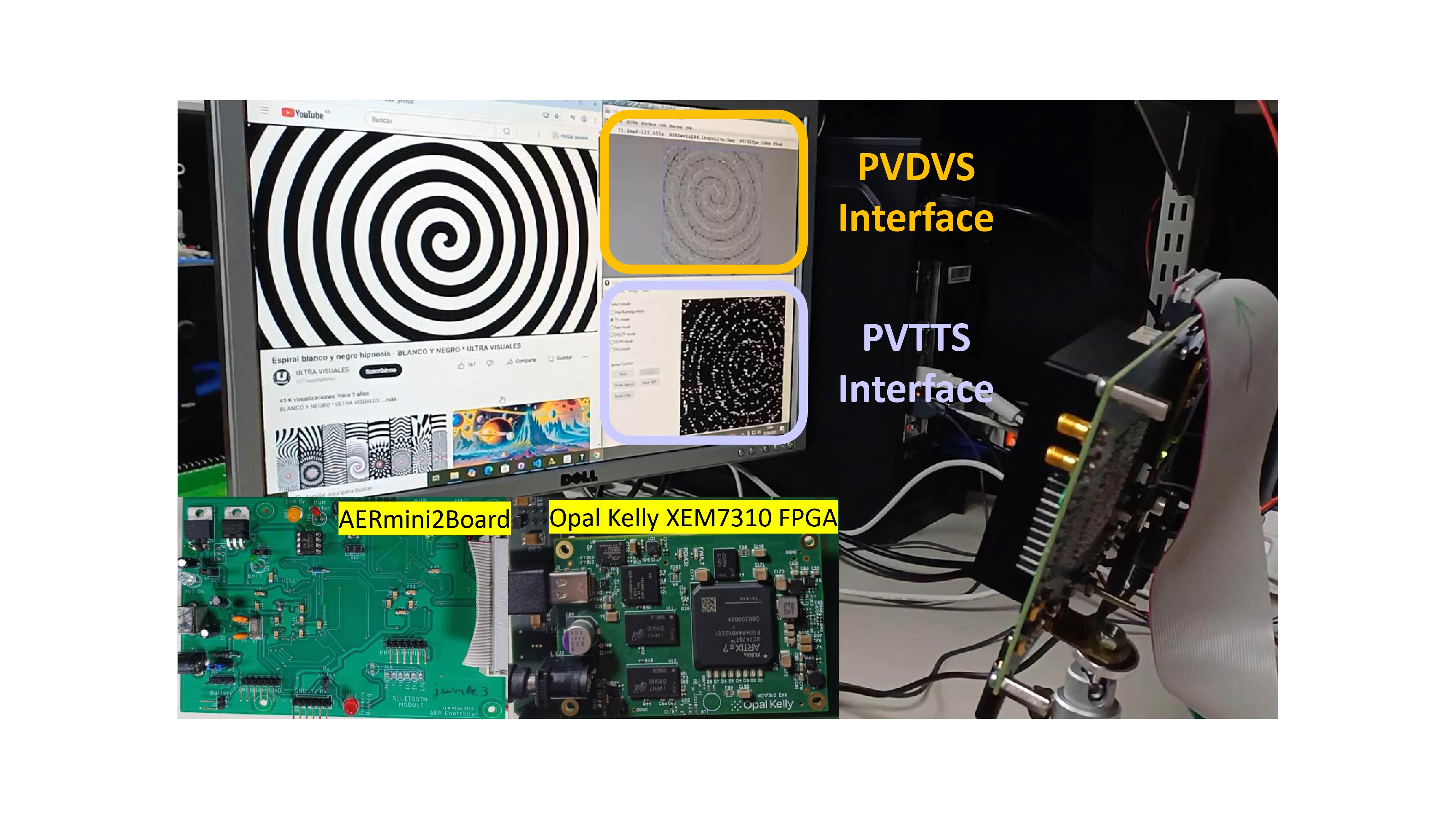
Asynchronous Time-Based Image Sensors (ATIS) jointly perform event-driven temporal contrast detection and local exposure measurement, reducing throughput by reporting only relevant information with high temporal resolution. We introduce PVATIS, a new pixel front-end that replaces the conventional pair of reverse-biased photodiodes plus a logarithmic receptor with a single diode operated in photovoltaic mode. In open-circuit, this diode simultaneously serves as the photodetector and provides logarithmic compression in a self-biased configuration. The approach directly tackles pixel-level constraints, such as pixel pitch, noise, and energy, while trading off bandwidth due to increased integrated capacitance. PVATIS is therefore a strong candidate for high-resolution, HDR, low-noise, and energy-efficient operation, particularly suitable for 3D-stacked implementations and moderate-speed imaging.
Pablo Fernández-Peramo, Sergio Palomeque-Mangut, Ángel Rodríguez-Vázquez, Juan A. Leñero-Bardallo, "An Asynchronous Time-based Image Sensor with a Photovoltaic Receptor" in Electronic Imaging, 2026, pp 282-1 - 282-6, https://doi.org/10.2352/EI.2026.38.6.ISS-282