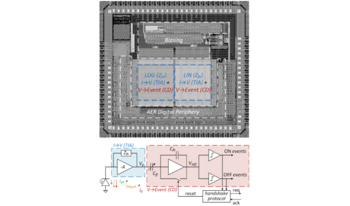
Event-driven imaging enables low-latency, high-throughput sensing by reporting only temporal changes in a scene. A comparison of event-based and frame-based cameras under I/O-limited conditions shows that event-driven sensors achieve higher effective frame rates and lower latency in sparse scenes, while approaching frame-based limits as scene activity increases. Extending event-driven sensing to infrared (IR) wavelengths is challenged by elevated dark current and background-induced photocurrent. The limitations of conventional logarithmic (LOG) front-ends are analyzed, and performance is compared with a linear (LIN) front-end exhibiting stable conversion gain under high background conditions. Results indicate improved contrast sensitivity and minimum event temperature at high background, with LOG and LIN architectures each providing advantages over different background regimes.
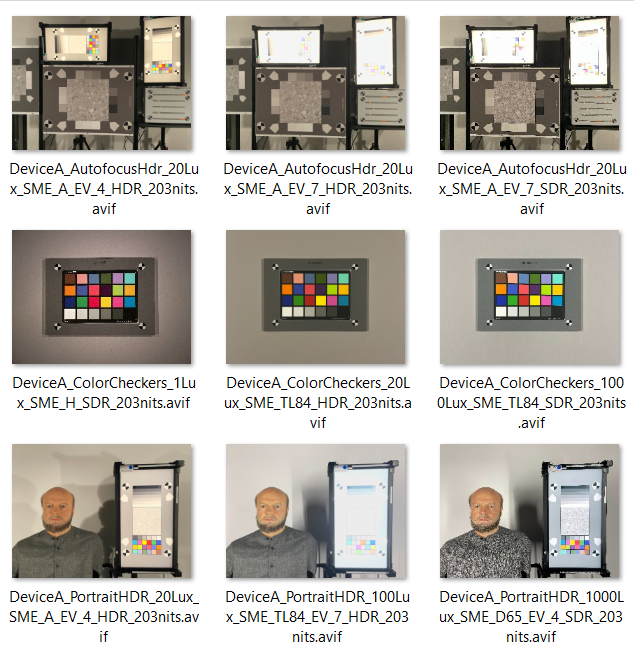
This paper is the continuation of a previous work, which aimed to develop a color rendering model using ICtCp color space, to evaluate SDR and HDR-encoded content. However, the model was only tested on an SDR image dataset. The focus of this paper is to provide an analysis of a new HDR dataset of laboratory scenes images using our model and additional color rendering visualization tools. The new HDR dataset, captured with different devices and formats in controlled laboratory setups, allows the estimation of HDR performances, encompassing several key aspects including color accuracy, contrast, and displayed brightness level, in a variety of lighting scenarios. The study provides valuable insights into the color reproduction capabilities of modern imaging devices, highlighting the advantages of HDR imaging compared to SDR and the impact of different HDR formats on visual quality.

High Dynamic Range (HDR) videos attract industry and consumer markets thanks to their ability to reproduce wider color gamuts, higher luminance ranges and contrast. While the cinema and broadcast industries traditionally go through a manual mastering step on calibrated color grading hardware, consumer cameras capable of HDR video capture without user intervention are now available. The aim of this article is to review the challenges found in evaluating cameras capturing and encoding videos in an HDR format, and improve existing measurement protocols to objectively quantify the video quality produced by those systems. These protocols study adaptation to static and dynamic HDR scenes with illuminant changes as well as the general consistency and readability of the scene’s dynamic range. An experimental study has been made to compare the performances of HDR video capture to Standard Dynamic Range (SDR) video capture, where significant differences are observed, often with scene-specific content adaptation similar to the human visual system.
3D-LUTs are widely used in cinematography to map one gamut into another or to provide different moods to the images via artistic color transformations. Most of the time, these transformations are computed off-line and their sparse representations stored as 3D-LUTs into digital cameras or on-set devices. In this way, the director and the on-set crew can see a preview of the final results of the color processing while shooting. Unfortunately, these kind of devices have strong hardware constraints, so the 3D-LUTs shall be as small as possible, but always generating artefact-free images. While for the SDR viewing devices this condition is guaranteed by the dimension 33×33×33, for the new HDR and WCG displays much larger and not feasible 3DLUTs are needed to generate acceptable images. In this work, the uniform lattice constrain of the 3D-LUT has been removed. Therefore, the position of the vertices can be optimized by minimizing the color error introduced by the sparse representation. The proposed approach has shown to be very effective in reducing the color error for a given 3D-LUT size, or the size for a given error.