 Find this author on Google Scholar
 Find this author on PubMed


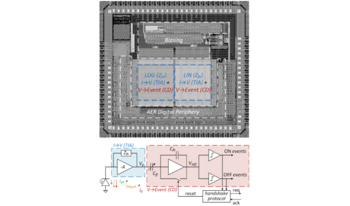
Event-driven imaging enables low-latency, high-throughput sensing by reporting only temporal changes in a scene. A comparison of event-based and frame-based cameras under I/O-limited conditions shows that event-driven sensors achieve higher effective frame rates and lower latency in sparse scenes, while approaching frame-based limits as scene activity increases. Extending event-driven sensing to infrared (IR) wavelengths is challenged by elevated dark current and background-induced photocurrent. The limitations of conventional logarithmic (LOG) front-ends are analyzed, and performance is compared with a linear (LIN) front-end exhibiting stable conversion gain under high background conditions. Results indicate improved contrast sensitivity and minimum event temperature at high background, with LOG and LIN architectures each providing advantages over different background regimes.
Roman Fragasse, Megan Manifold, Ramy Tantawy, Shane Smith, Jonathan Bergey, "Asynchronous Event-based Sensors: A Case Study for Infrared Readout Integrated Circuits" in Electronic Imaging, 2026, pp 285-1 - 285-8, https://doi.org/10.2352/EI.2026.38.6.ISS-285