Back to articles
Work Presented at Electronic Imaging 2026
Volume: 70 | Article ID: 020401
Image
Evaluation of SOI Lock-in Pixels with Improved Modulation Contrast
  DOI :  10.2352/J.ImagingSci.Technol.2026.70.2.020401  Published OnlineMarch 2026
Abstract
Abstract

Time-resolved imaging requires image sensors with high-speed modulation and a thick sensing layer for high sensitivity to near-infrared light and high-energy photon and particle detection. A solution is a lock-in pixel based on a silicon on insulator (SOI) with a fully depleted thick substrate; however, such pixels face challenges from degraded modulation contrast due to high parasitic light sensitivity (PLS) in the floating diffusion region. This work presents a pixel architecture that suppresses the PLS while preserving fast charge transfer by introducing a shallow buried channel and intermediate gates that enhance the lateral electric field. A prototype four-tap pixel array was fabricated using 0.2 μm SOI technology and experimentally characterized under 940 nm pulsed laser illumination. The proposed structure achieved a modulation contrast of 92.5% and PLS below 1.2% under 40 ns gate-pulse operation, maintaining stable performance up to 35,000 electrons per pulse, demonstrating suitability for X-ray and electron-beam imaging.

Subject Areas :
Views 36
Downloads 6
 articleview.views 36
 articleview.downloads 6
  Cite this article 

Yudai Shinohara, Keita Yasutomi, Ryo Imai, Keiichiro Kagawa, Shoji Kawahito, "Evaluation of SOI Lock-in Pixels with Improved Modulation Contrastin Journal of Imaging Science and Technology,  2026,  pp 1 - 8,  https://doi.org/10.2352/J.ImagingSci.Technol.2026.70.2.020401

 Copy citation
  Copyright statement 
Copyright © Society for Imaging Science and Technology 2026
 Open access
  Article timeline 
  • received August 2025
  • accepted December 2025
  • PublishedMarch 2026
jist
JIMTE6
Journal of Imaging Science and Technology
J. Imaging Sci. Technol.
1062-3701
1943-3522
Society for Imaging Science and Technology
1.
Introduction
Lock-in pixel image sensors, which enable high-speed electronic shuttering synchronized with an optical source, are being actively developed for a variety of applications, including time-of-flight (ToF) imaging [110], fluorescence lifetime imaging [1113], time-resolved near-infrared (NIR) spectroscopy [14], and non-contact heart rate detection [15, 16]. One of the key challenges for such lock-in pixels is achieving high sensitivity in the long-wavelength region while maintaining the high-speed electronic shutter function.
To enhance sensitivity to NIR light, the authors have proposed a pixel structure that enables lock-in detection based on a silicon-on-insulator (SOI) pixel sensor [1720] featuring a thick depletion region. The SOI lock-in pixel is designed to fully deplete a substrate thicker than 100 μm, which allows for a quantum efficiency exceeding 90% in the NIR range. Compared to recently reported structures that use multiple reflections within deep trench isolation layers [4], the proposed design offers even higher quantum efficiency. The thick absorption layer is also attractive in applications such as X-ray [1521] and electron-beam detection [22].
However, the previous pixel structure [10] is constrained by a low modulation contrast (MC) mainly due to the high parasitic light sensitivity (PLS) of floating diffusion (FD) regions. At specific values, this leakage mechanism accounts for the measured PLS exceeding 13%, which leads to a low modulation contrast of approximately 58%. The issue arises from the fundamental potential design and cannot be sufficiently resolved by the optimization of doping energy and/or concentration. In this study, we present an SOI-based lock-in pixel with improved modulation contrast. The newly proposed structure [23] has a shallow buried channel to enhance the charge-shielding capability of FDs to improve the modulation contrast. In our previous study [23], the effectiveness of the proposed structure was verified through device simulations. This paper presents the fabrication and experimental evaluation of the proposed pixel, focusing on its modulation contrast performance. As a result, the proposed pixel achieves a modulation contrast of 92.5% with a PLS below 1.2% under pulsed operation. Compared with the conventional pixel, this corresponds to an 11.4× reduction in PLS and a 1.6× increase in MC.
The remainder of this paper is organized as follows. Section 2 describes a brief overview of the SOI lock-in pixel and the issue with the previous structure. Section 3 details the proposed pixel structure and a prototype chip. Section 4 reports the measurement results of the prototype chip. The conclusion is presented in Section 5.
2.
An SOI-based Lock-in Pixel Structure
2.1
Overview of the SOI-based Lock-in Pixel
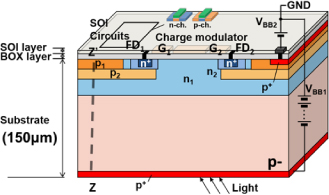
Figure 1 shows a conceptual diagram of a previously developed SOI-based lock-in pixel [10] and its potential diagrams. The SOI-based lock-in pixel was developed based on SOI pixel technology [17], where the substrate is used as a sensing layer. For high sensitivity and fast response, the thick substrate is fully depleted by applying a substrate bias (VBB1). Similar to SOI pixel technology [17], the SOI-based lock-in pixel exhibits inherent radiation hardness [24, 25] due to the thick substrate. The combination of this feature and high-speed lock-in operation (viz., electronic shuttering) is attractive for applications such as time-resolved X-ray imaging [21] and high-speed direct electron detection [22].
Figure 1.
The SOI-based lock-in pixel structure. Concept of potential design for the proposed SOI-based lock-in detector (two-tap).
The modulation gates are formed on top of the buried oxide (BOX) layer using n+ or p+ layers, which serve as the source/drain active layers in standard SOI transistors. This SOI gate structure allows modulation of the channel potential, thereby enabling charge modulation functionality. The center gate (Gc) is biased to a constant negative voltage while the modulation gates (G1, G2, G3, and G4) are driven with negative gate pulses (e.g., −7 V to −3 V), creating a buried channel beneath the gates. In particular, when the modulation gates are set low, the front-surface potential is pinned to the front-surface bias, VBB2. The n1 layer also plays an important role in preventing leakage current between the front-side p-type layers (p1 and p2) and backside p-type substrate. The p1 layer is formed beneath the BOX layer to suppress generation current and back-gate effects, ensuring the stable operation of SOI circuits [17]. The p2 layer creates a potential barrier under n+ layers (FDs) to suppress the PLS.
2.2
Conventional Pixel Structure and its Issue
Figure 2 shows the four-tap implementation of the SOI lock-in pixel and its corresponding simulated potential distributions. As described previously, the conventional structure exhibits significant PLS. This issue primarily arises because the buried channel (n1) is located relatively deep within the substrate, and a highly doped n2 region is required to connect the buried channel to the FDs. The high doping concentration in the n2 region weakens the potential barrier formed by the p2 layer. This results in a residual connection between the buried channel and the FDs even when the corresponding modulation gate is turned off. As a result, signal electrons generated under off-state gates or near the pixel edges can leak into unintended FDs, leading to large PLS.
Figure 2.
The SOI-based lock-in pixel in the previous design: (a) pixel layout with four floating diffusions (FD1–FD4) and transfer gates (G1–G4); (b) simulated potential cross-section along X–X′ showing the buried channel (n1) and a weak barrier under the p2 region. Electrons from positions A and B () are correctly collected while those from C–E (×) leak to other FDs, causing PLS.
The device simulation results in Fig. 2(b) explain this behavior. Electrons generated at positions A and B are correctly collected by FD1, whereas electrons generated at C, D, and E are incorrectly collected by the off-state FD due to the insufficient potential barrier. Figure 3 shows an example of the measured modulation characteristic of the conventional pixel. The results were obtained using a 100 ps short-pulse light source at 930 nm, and the modulation gates were set at 40 ns. The outputs of the four taps (G1–G4) are plotted along with their sum. It can be seen that each tap exhibits a constant offset of approximately 13% of the total signal even when the corresponding modulation gate is off. This offset represents PLS since some electrons generated within the pixel are partially collected by the off-state FDs. This leakage mechanism accounts for the measured PLS exceeding 13%, which leads to a low modulation contrast of approximately 58%.
Figure 3.
Modulation characteristics of the previous structure. A short-pulse light source with approximately 100 ps width and 930 nm wavelength was used. The gate-pulse width was set at 40 ns. A large PLS was observed as an offset.
3.
Proposed Pixel and Fabricated Chip
3.1
Proposed Pixel Structure
The proposed SOI-based lock-in pixel was developed to suppress PLS and improve modulation contrast. In this design [23], the buried channel structure of the conventional pixel is significantly modified. The central region of the n1 layer is removed, and an additional n3 layer with lower implant energy is introduced to form a shallower buried channel. This structural change enhances controllability of the potential by the modulation gates and allows the p2 barrier under the FDs to be formed more effectively.
However, a shallow buried channel weakens the lateral electric field near the surface, which is essential for high-speed charge transfer in lock-in operation. To address this issue, the proposed pixel also introduces intermediate gates (GC1–GC4) between the center gate (GC) and the modulation gates (G1–G4) as shown in Figure 4(a) [23]. These intermediate gates smooth the lateral potential distribution in the buried channel and generate a lateral electric field as shown in Fig. 4(b). Figure 5 shows simulated one-dimensional and two-dimensional potential distributions with and without the intermediate gates. Without the intermediate gates, a small potential dip appears due to the weakened fringing field. The dip is eliminated by introducing the intermediate gates, resulting in a smoother potential profile and a stronger lateral electric field. This enables high-speed charge transfer while maintaining low PLS.
Figure 4.
SOI-based lock-in pixel in the proposed design: (a) pixel layout with four floating diffusions (FD1–FD4) and transfer gates (G1–G4); (b) simulation result.
Figure 5.
Simulated potential distribution along the transfer path. Red (solid): with intermediate gates; black (dashed): without intermediate gates. Without intermediate gates, a local potential dip appears and the lateral field is weak. With intermediate gates, the potential transition becomes monotonic and the lateral field is strengthened, enabling faster charge transfer.
The timing diagram of the proposed pixel in a four-tap ToF operation as an example is illustrated in Figure 6. The modulation gates (G1–G4) are sequentially turned on in synchronization with the incident light pulses while the intermediate gates (GC1–GC4) are also driven with slightly delayed pulses relative to their neighboring modulation gates.
Figure 6.
The timing diagram for the four-tap lock-in pixel with intermediate-gate-assisted operation.
Although the shallow buried channel and intermediate gates effectively improve the modulation contrast and suppress PLS, potential trade-offs should be noted. To form the shallow channel, the proposed pixel requires one additional mask and process step. In addition, driving the intermediate gates may slightly increase power consumption; however, this increase can be limited because the required switching speed of the intermediate gates is lower than that of the modulation gates. Another possible issue is that the proposed structure requires careful alignment between the n1 and p2 layers, which can affect yield. For this issue, further investigation is necessary to optimize the layout, doping profiles, and driving pulse voltages.
3.2
Implemented ToF Sensor Chip
Figure 7 shows the die micrograph of the implemented ToF sensor fabricated using 0.2 μm SOI technology. The pixel array consists of 70 (H) × 170 (V), with a pixel pitch of 18 μm × 18 μm. The sensor integrates a four-tap gate driver (G1–G4, GD), the pixel array, vertical and horizontal scanners, and a column-parallel readout circuit with correlated double sampling. After column-wise signal scanning by the H-Scanner, analog signals are externally digitized using a 14-bit analog-to-digital converter.
Figure 7.
Prototype chip photograph, pixel circuit, and demodulator.
4.
Evaluation Results
4.1
Output and PLS Under DC Illumination
The photoresponse of the proposed SOI-based lock-in pixel was measured under DC illumination to evaluate the linearity of each tap and to assess the PLS. A 940 nm laser operating in DC mode was used as the light source. Figure 8 shows the measurement results, where one modulation gate was set high while the others were set low. The outputs represent the average of 885 pixels. A clear difference between the high-state and low-state tap outputs was observed. Table I summarizes the resulting PLS values for each condition, showing that the PLS was effectively reduced to below 2.9%. Notably, when only G2 was turned on, the PLS was further suppressed to as low as 1.13%. The PLS variation among taps may occur due to differences in the potential barrier under the gates when they are turned off. One possible cause is the mask alignment error between the doping layers, such as p2 and n2. This issue will be further investigated and optimized in future layout revisions.
Figure 8.
Measured photoresponse under DC illumination where only one modulation gate is set high in each condition during the accumulation phase: (a) G1 is high; (b) G2 is high; (c) G3 is high; (d) G4 is high. All other gates are set low. The gate GD is set high during the readout phase.
Table I.
Summary of the PLS values for each tap calculated under static DC illumination conditions.
ON gateG1G2G3G4
PLS (%)2.891.132.862.27
The measurement results of dark current at 27C are summarized in Table II. The measured dark currents are 8.5 × 10⁴, 8.9 × 10⁴, 6.7 × 10⁴, and 8.4 × 10⁴ e∕s for G1, G2, G3, and G4, respectively. Here, the conversion gain is assumed to be 10 μV∕e. During the measurement, a modulation gate pulse of 40 ns with a repetition period of 520 ns was applied. Since the sensor operates in global-shutter mode, the dark current generated in the FD region is also included in these results.
Table II.
Estimated FD-hold dark current for each tap obtained from the mean slope of FD voltage decay during light-off intervals (assuming CG = 10 μV∕e).
GateG1G2G3G4
Dark current (e/s)8.5 × 1048.9 × 1046.7 × 1048.4 × 104
4.2
Modulation Contrast Characteristics
The modulation characteristics of the proposed pixel were evaluated under pulsed illumination. A 940 nm short-pulse laser (LDB-160B, Tama Electric Inc.) with a pulse width of 100 ps and a repetition period of 520 ns was used as the light source. The laser trigger delay was scanned from 0 to 300 ns in steps of 1 ns, and the modulation gate pulse was set at 40 ns. To demonstrate the effectiveness of the intermediate gates, two operation conditions were evaluated: intermediate-gate-assisted operation (normal operation as shown in Fig. 6) and non-assisted operation (where the intermediate gates are set low during the accumulation phase). The measurement results are shown in Figures 9 and 10, respectively.
Figure 9.
The modulation characteristics in the intermediate-gate-assisted condition (normal operation as shown in Fig. 6).
Figure 10.
The modulation characteristics in the non-assisted operation (where the intermediate gates are set low during the accumulation phase).
Under the intermediate-gate-assisted operation, high-speed modulation was observed and the outputs of off-state gates corresponding to PLS remained low. In contrast, the non-assisted operation showed slow modulation, particularly at the rising edges of the modulation characteristics. The rising edges in the modulation characteristics correspond to the falling edges of the light pulse and the associated photocurrent response, suggesting that the low-speed operation may result from a weakened lateral electric field operation.
The average PLS from the modulation characteristic with the intermediate-gate-assisted operation was 1.2%, and the modulation contrast, defined later in Eq. (1), was measured to be 92.5%. In the non-assisted operation, the average PLS increased to 5.2% and the modulation contrast decreased to 43.9%. These results are better than those of the previous structure, demonstrating that the combination of the shallow buried channel and intermediate-gate-assisted operation enables both high-speed modulation and low PLS.
The modulation contrast is calculated as follows:
(1)
MC =14i=14max2SiSSUMSSUM,SSUM=k=14Sk,
where Si is the output of the ith tap and SSUM is the sum of all four tap outputs. Unlike [26], our sensor employs a four-tap modulation scheme using short light pulses (i.e., not a 50% duty cycle). Therefore, we adopted the extended definition shown in Eq. (1), following the approach of [10].
4.3
Modulation Characteristics at High Signal Levels
In applications such as X-ray or electron-beam detectors, a single incident electron can generate a large number of signal electrons. To emulate this scenario, modulation measurements were conducted under various incident laser power conditions corresponding to different levels of signal injection per pulse. In this measurement, the number of photogenerated electrons per pulse (e/pulse) owing to short-pulse laser irradiation was varied with a beam splitter, and both the average PLS and the modulation contrast were evaluated. Figures 11 and 12 show the results of the leakage and modulation contrast as a function of photogenerated electrons per pulse. The conversion gain is assumed to be 10 μV/e. The modulation characteristic remained correct even at approximately 35,000 electrons per pulse, and the PLS was negligibly small. The modulation characteristic measured at approximately 35,000 electrons per pulse is shown in Figure 13, demonstrating that the pixel operates correctly even under near-saturation conditions.
Figure 11.
Average PLS of the four taps as a function of the number of photogenerated electrons per pulse.
Figure 12.
Measured MC versus photogenerated electrons per pulse.
Figure 13.
Modulation characteristics at a high number of photogenerated electrons (35,000 e/pulse).
5.
Conclusions
We have developed and evaluated a four-tap SOI-based lock-in pixel structure that combines a shallow buried channel with intermediate gates to improve modulation contrast and suppress PLS. Experimental results demonstrated low PLS under both static and pulsed illumination. The proposed pixel achieved a modulation contrast of 92.5% with a PLS of only 1.2%, significantly outperforming the conventional design. Furthermore, the pixel maintained stable operation under high signal injection conditions—up to approximately 35,000 electrons per pulse—with minimal performance degradation. These results confirm that the proposed pixel is well suited for high-sensitivity, high-speed imaging applications, including ToF range imaging, X-ray sensing, and direct electron detection.
Acknowledgment
This work was supported by JST, CREST, JPMJCR22C, and in part by KAKENHI 22H01547. Part of this work was carried out under the Cooperative Research Project Program of the Research Institute of Electrical Communication, Tohoku University.
The chip design was also supported through the activities of VDEC, d.lab, and The University of Tokyo in collaboration with Cadence Design Systems and Siemens Electronic Design Automation Japan K.K.
The authors also thank LAPIS Semiconductor Co. Ltd. for the chip fabrication.
References
1SpirigT.SeitzP.VietzeO.HeitgerF.1995The lock-in CCD-two-dimensional synchronous detection of lightIEEE J. Quantum Electron.31170510.1109/3.406386
2YasutomiK.KawahitoS.2022Lock-in pixel base time-of-flight range imagers: an overviewIEICE Trans. Electron.E105–C30110.1587/transele.2021CDP0004
3EbikoY.YamagishiH.TataniK.IwamotoH.MoriyamaY.HagiwaraY.MaedaS.MuraseT.SuwaT.AraiH.2020Low power consumption and high resolution 1280X960 gate assisted photonic demodulator pixel for indirect Time of flightIEEE International Electron Devices Meeting (IEDM), 33.1.1IEEEPiscataway, NJ10.1109/IEDM13553.2020.9372109
4KeelM.-S.KimD.KimY.BaeM.KiM.ChungB.SonS.LeeH.ShinS.-C.KyeM.2021A 1.2-Mpixel indirect time-of-flight image sensor with 4-Tap 3.5-μm pixels for peak current mitigation and multi-user interference cancellationIEEE J. Solid-State Circuits56320910.1109/JSSC.2021.3112405
5YokogawaS.OshiyamaI.IkedaH.EbikoY.HiranoT.SaitoS.OinoueT.HagimotoY.IwamotoH.2017IR sensitivity enhancement of CMOS Image Sensor with diffractive light trapping pixelsSci. Rep.7383210.1038/s41598-017-04200-y
6ParkJ.LeeY.KimB.KimB.ParkJ.YeomE.JungY.KimT.YoonH.KimY.ParkJ.MoonC. R.ParkY.2019Pixel technology for improving IR quantum efficiency of backside- illuminated CMOS image sensorInternational Image Sensor Workshop (IISW)4141–4International Image Sensor Society (IISS)Snowbird, UT, USAR14
7KawahitoS.YasutomiK.MarsK.2022Hybrid time-of-flight image sensors for middle-range outdoor applicationsIEEE Open J. Solid-State Circuits Soc.23810.1109/OJSSCS.2021.3133224
8HatakeyamaK.OkuboY.NakagomeT.MakinoM.TakashimaH.AkutsuT.SawamotoT.NagaseM.NoguchiT.KawahitoS.2023A hybrid ToF image sensor for long-range 3D depth measurement under high ambient light conditionsIEEE J. Solid-State Circuits5898310.1109/JSSC.2023.3238031
9KuoC.-C.KurodaR.2024A 134×132 4-Tap CMOS indirect time-of-flight range imager using in-pixel memory array With 10 Kfps high-speed mode and high precision modeIEEE J. Solid-State Circuits5949210.1109/JSSC.2023.3281610
10LeeS.YasutomiK.MoritaM.KawanishiH.KawahitoS.2020A Time-of-flight range sensor using four-tap lock-in pixels with high near infrared sensitivity for LiDAR applicationsSensors2011610.3390/s20010116
11SeoM.-W.KagawaK.YasutomiK.KawataY.TeranishiN.LiZ.HalinI. A.KawahitoS.2016A 10 ps time-resolution CMOS image sensor with two-tap true-CDS lock-in pixels for fluorescence lifetime imagingIEEE J. Solid-State Circuits5114110.1109/JSSC.2015.2496788
12SeoM.-W.ShirakawaY.KawataY.KagawaK.YasutomiK.KawahitoS.2018A time-resolved four-tap lock-in pixel CMOS image sensor for real-time fluorescence lifetime imaging microscopyIEEE J. Solid-State Circuits53231910.1109/JSSC.2018.2827918
13HofmannA.SaftB.ReichP.GrabmannM.GläserG.TrübenbachM.RolappA.ReinhardM.ScholzF.SchäferE.2022Lock-in pixel CMOS image sensor for time-resolved fluorescence readout of lateral-flow assaysIEEE Trans. Biomed. Circuits Syst.1653510.1109/TBCAS.2022.3192926
14LioeD. X.FukushiY.HakamataM.NiwayamaM.MarsK.YasutomiK.KagawaK.YamamotoS.KawahitoS.2023A CMOS lock-in pixel image sensor with multisimultaneous gate for time-resolved near-infrared spectroscopyIEEE Trans. Electron Devices70110210.1109/TED.2023.3236591
15CaoC.ShirakawaY.TanL.SeoM.-W.KagawaK.YasutomiK.KosugiT.AoyamaS.TeranishiN.TsumuraN.2018A two-tap NIR lock-in pixel CMOS image sensor with background light cancelling capability for non-contact heart rate detectionIEEE Symposium on VLSI Circuits75IEEEPiscataway, NJ10.1109/VLSIC.2018.8502349
16CaoC.DuttaJ. K.HakamataM.YasutomiK.KagawaK.AoyamaS.2021A dual NIR-band lock-in pixel CMOS image sensor with device optimizations for remote physiological monitoringIEEE Trans. Electron Devices68168810.1109/TED.2021.3057035
17AraiY.MiyoshiT.UnnoY.TsuboyamaT.TeradaS.IkegamiY.IchimiyaR.KohrikiT.TauchiK.IkemotoY.2011Development of SOI pixel process technologyNucl. Instrum. Methods Phys. Res. A636S3110.1016/j.nima.2010.04.081
18KamehamaH.KawahitoS.ShresthaS.NakanishiS.YasutomiK.TakedaA.TsuruT. G.AraiY.2018A low-noise X-ray astronomical silicon-on-insulator pixel detector using a pinned depleted diode structureSensors1810.3390/s18010027
19HaginoK.KitajimaM.KohmuraT.KurachiI.TsuruT. G.YukumotoM.TakedaA.MoriK.NishiokaY.TanakaT.2023Radiation-induced degradation mechanism of X-ray SOI pixel sensors with pinned depleted diode structureIEEE Trans. Nucl. Sci.70144410.1109/TNS.2023.3287130
20HaginoK.OonoK.NegishiK.YaritaK.KohmuraT.TsuruT. G.TanakaT.UchidaH.HaradaS.OkunoT.2019Measurement of charge cloud size in X-ray SOI pixel sensorsIEEE Trans. Nucl. Sci.66189710.1109/TNS.2019.2920281
21LeeY.OangK. Y.KimD.IheeH.2024A comparative review of time-resolved X-ray and electron scattering to probe structural dynamicsStruct. Dyn.1103130110.1063/4.0000249
22IshidaT.SugieK.MiyoshiT.IshidaY.SaitohK.AraiY.KuwaharaM.2024Development of silicon-on-insulator direct electron detector with analog memories in pixels for sub-microsecond imagingMicroscopy7351110.1093/jmicro/dfae029
23KobayashiT.YasutomiK.TakadaN.KawahitoS.2023An SOI-based lock-in pixel with a shallow buried channel for reducing parasitic light sensitivity and improving modulation contrastIEICE Trans. Electron.E106.C53810.1587/transele.2022CTP0003
24TsunomachiS.KohmuraT.HaginoK.KitajimaM.DoiT.AokiD.OhiraA.ShimizuY.FujisawaK.YamazakiS.UchidaY.ShimizuM.ItohN.AraiY.MiyoshiT.NishimuraR.TsuruT. G.KurachiI.2022Proton radiation damage tolerance of wide dynamic range SOI pixel detectorsProc. SPIE12191121910C10.1117/12.2629771
25HayashidaM.HaginoK.KohmuraT.KitajimaM.YaritaK.OonoK.NegishiK.TsuruT. G.TanakaT.UchidaH.2021Proton radiation hardness of X-ray SOI pixel sensors with pinned depleted diode structureJ. Astron. Telesc. Instrum. Syst.710.1117/1.JATIS.7.3.036001
26KeelM.-S.JinY.-G.KimY.KimD.KimY.BaeM.ChungB.SonS.KimH.AnT.2020A VGA indirect time-of-flight CMOS image sensor with 4-Tap 7-μm global-shutter pixel and fixed-pattern phase noise self-compensationIEEE J. Solid-State Circuits5588910.1109/JSSC.2019.2959502