 Find this author on Google Scholar
 Find this author on PubMed


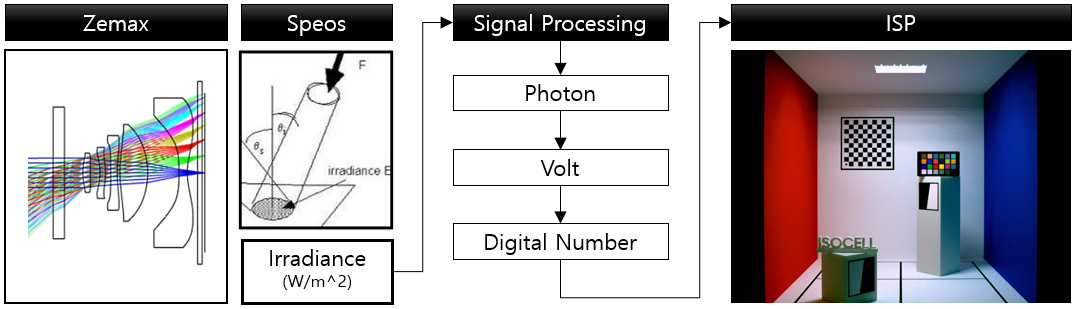
This paper presents the development of an end-to-end digital twin system for CMOS Image Sensors (CIS) by leveraging Ansys Zemax, Speos, and Lumerical. We extracted the geometric and material data of an actual smartphone camera lens using Zemax, and calculated the irradiance post-lens through Spectral-based ray tracing simulations in Speos. Subsequently, Lumerical was utilized to precisely model pixel-level Quantum Efficiency (QE) across various wavelengths and optical fields, culminating in the generation of simulation-based digital images. The reliability and accuracy of this model were validated in a Cornell box-based environment by comparing the consistency of ESF, chromatic aberration, distortion, and chromaticity (CIE 1931) between experimental captures and digital twin simulations.
Jeongyong Shin, Seonghyeon Kang, Sangmin Kim, Jinhee Kim, Sebastien Noygues, Jeongwoo Son, Hyuntaek Choi, Jeongwook Lee, Sung-Su Kim, Yitae Kim, "End-to-End CIS Digital Twin Using Lens Geometry Spectral Ray Tracing and Pixel Modeling" in Electronic Imaging, 2026, pp 251-1 - 251-6, https://doi.org/10.2352/EI.2026.38.8.IQSP-251