 Find this author on Google Scholar
 Find this author on PubMed


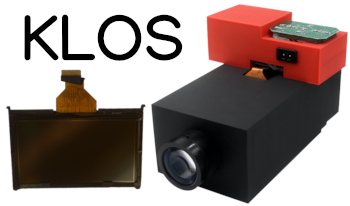
Compressed sensing allows reconstruction of complete image data from sparse sampling. In sequential single-sensel imaging, a spatial light modulator is used to select groups of pixel locations whose transmitted or reflected light is measured by a single detector. This function is commonly implemented using a digital micromirror device (DMD), but DMDs are relatively small and expensive. This work investigates the use of a transmissive liquid crystal display (LCD) panel as a lower-cost, larger-format alternative. The Kentucky LCD One Sensel (KLOS) prototype repurposes a consumer projector LCD and its control electronics, combining them with custom 3D-printed camera components, a projector lens, and a Fresnel lens. Preliminary testing demonstrates that both random and deterministic binary patterns can be used successfully, confirming the feasibility of the concept. However, serious practical limitations were observed, including sample-rate limitations imposed by HDMI control, synchronization lag, limited LCD contrast, and strong sensitivity to panel-to-sensor alignment.
Henry Dietz, Bashar Issahaku, "Single-sensel Image Capture Using an LCD Panel" in Electronic Imaging, 2026, pp 286-1 - 286-5, https://doi.org/10.2352/EI.2026.38.6.ISS-286