 Find this author on Google Scholar
 Find this author on PubMed
Technische Hochschule Brandenburg, Germany
German University of Applied Science, Germany


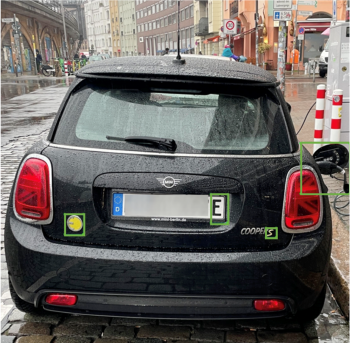
The rapid growth of electric vehicles (EVs) has introduced new challenges for urban parking management, mainly in enforcing EV-designated parking spaces without intrusive infrastructure. This paper presents a deep-learning-based vision system for the automated classification of electric and gasoline vehicles in urban parking environments, using convolutional neural networks trained on real-world data from Berlin, Germany. A YOLO-based object detection model is employed to identify visually distinctive EV-specific features in rear-view vehicle images while preserving privacy by anonymizing license plates. The proposed approach relies solely on visual cues, eliminating the need for vehicle metadata, sensors, or network connectivity. Experimental results demonstrate robust classification performance, achieving high detection accuracy and consistent results across desktop and edge computing platforms. To validate real-world applicability, the trained model is deployed on both a mobile device and a low-cost Raspberry Pi-based edge system, enabling fully offline operation. These results indicate that deep learning-based visual classification can provide a scalable, privacy-aware solution for smart parking systems and urban mobility applications. This supports the effective management of EV infrastructure in modern cities.
Raghav Tandon, Hamid Mostofi, Navaneeth Shivananjappa, Reiner Creutzburg, "Deep Learning Based Vehicle Classification: Detecting EVs and Gasoline Cars in Berlin using Convolutional Neural Networks" in Electronic Imaging, 2026, pp 327-1 - 327-7, https://doi.org/10.2352/EI.2026.38.3.MOBMU-327