 Find this author on Google Scholar
 Find this author on PubMed


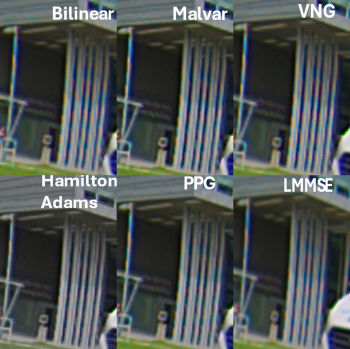
This paper presents brilliantISP, a modular, open-source HDR image signal processing pipeline for automotive camera applications. Unlike existing open-source ISPs, which employ floating-point arithmetic and are not optimized for HDR automotive use cases, brilliantISP adopts a predominantly fixed-point, unsigned integer architecture with explicit, bounded bit depths at each processing stage, mirroring the constraints of production embedded ISPs while remaining accessible for research and experimentation. The pipeline incorporates a configurable decompanding stage that reconstructs a linear-domain signal from piecewise-companded sensor outputs, supporting sensors with effective dynamic ranges up to 144 dB. Multiple global tone mapping operators are provided, including Reinhard, ACES, and Hable, alongside a Durand-style local tone mapping operator that decomposes the image into base and detail layers for contrast-preserving dynamic range compression. Additional pipeline stages include defect pixel correction, black level correction, lens shading correction, auto white balance, a choice of six demosaicing algorithms, local contrast and edge enhancement, and gamma correction. All stages are configurable via YAML parameter files, and comprehensive debug logging provides block-level execution statistics, dynamic range metrics, bit depth utilization, and histogram outputs to support both algorithm development and ISP tuning studies. The pipeline is validated on imagery from a Sony IMX623 split-pixel HDR fisheye sensor, where decompanded input spans approximately 19.26 EV at 20.7-bit effective depth, compressed to a 3.01 EV, 7.9-bit output after tone mapping and gamma correction. BrilliantISP is intended as a practical research platform for studying HDR tone mapping, demosaicing, and ISP tuning in the context of automotive computational photography.
Brian Deegan, "BrilliantISP: An Enhanced HDR Image Signal Processing Pipeline" in Electronic Imaging, 2026, pp 114-1 - 114-7, https://doi.org/10.2352/EI.2026.38.16.AVM-114