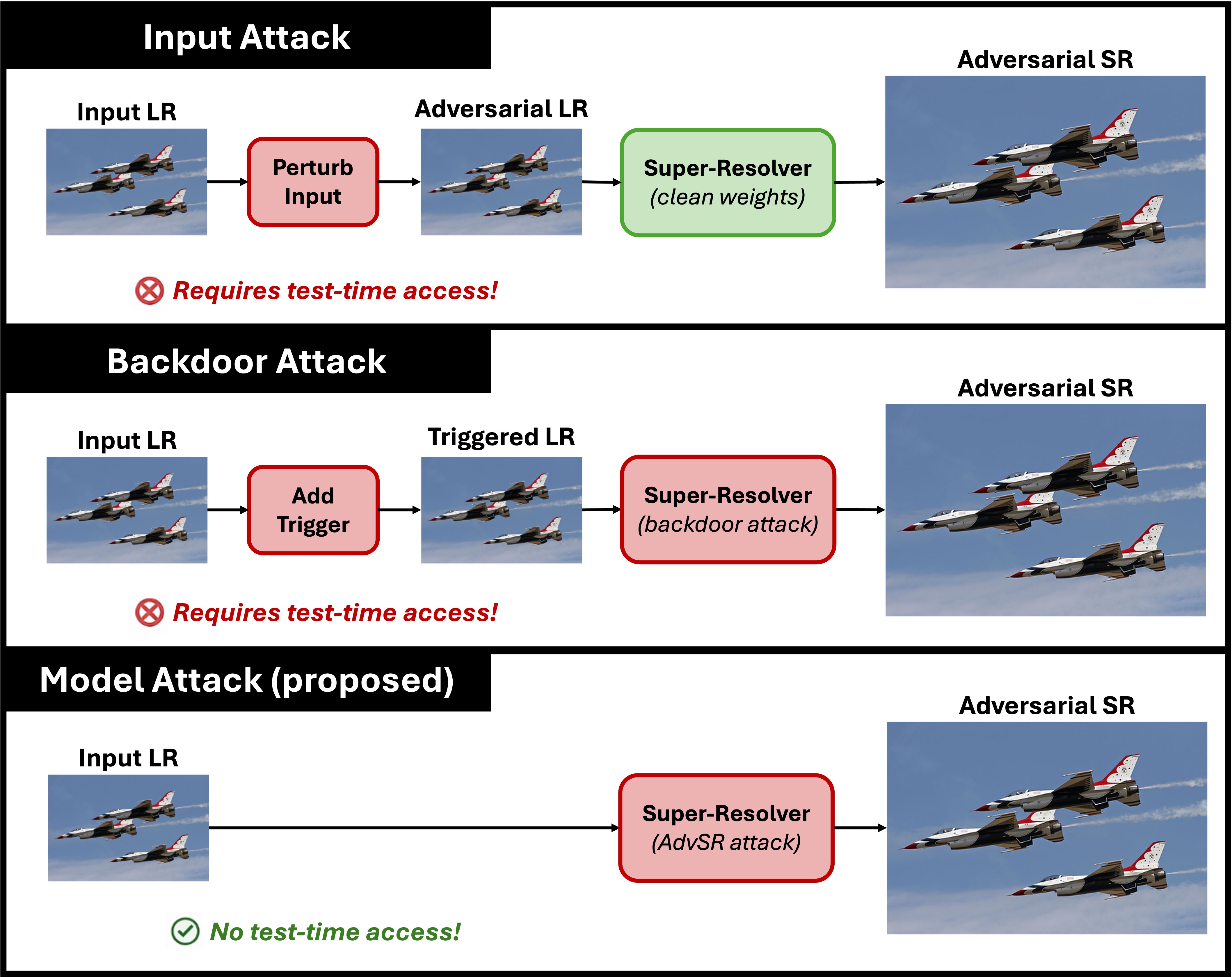
Data-driven super-resolution (SR) methods are often integrated into imaging pipelines as preprocessing steps to improve downstream tasks such as classification and detection. However, these SR models introduce a previously unexplored attack surface into imaging pipelines. In this paper, we present AdvSR, a framework demonstrating that adversarial behavior can be embedded directly into SR model weights during training, requiring no access to inputs at inference time. Unlike prior attacks that perturb inputs or rely on backdoor triggers, AdvSR operates entirely at the model level. By jointly optimizing for reconstruction quality and targeted adversarial outcomes, AdvSR produces models that appear benign under standard image quality metrics while inducing downstream misclassification. We evaluate AdvSR on three SR architectures (SRCNN, EDSR, SwinIR) paired with a YOLOv11 classifier and demonstrate that AdvSR models can achieve high attack success rates with minimal quality degradation. These findings highlight a new model-level threat for imaging pipelines, with implications for how practitioners source and validate models in safety-critical applications.

The inverse-imaging problem comprising the fusing of a hyperspectral image, possessing high spectral resolution, with a multispectral image, having high spatial resolution, to yield an image with high resolution both spatially and spectrally is considered. In particular, a prior state-of-the-art approach—low-rank tensor approximation (LRTA)—is revisited with the goal of simplifying its implementation and accelerating its execution speed. Whereas the original LRTA incorporated low-rank objectives both spatially and spectrally, the revised algorithm employs spectral low-rankness exclusively. Additionally, the reliance of LRTA on singular value thresholding (SVT)—an operator widely used to impose low-rankness in optimizations—is replaced with a fixed-basis approximation that eliminates the computationally costly singular value decomposition required by the SVT. The proposed modifications ultimately result in significant runtime speedup; furthermore, empirical results reveal improved fusion quality when compared to the original LRTA.

Ironically, it is often useful to manipulate 2D graphics for 3D printing. Trace2SCAD was originally written to convert 2D diagrams into printed structures that could be understood by a blind student feeling the surface. However, by its initial open source release in January 2015, it had already been applied to convert pixel-mapped images into parametric 3D models and 3D-printable image renderings (e.g., lithophanes). The original version was a shell script using a variety of helpers, especially potrace. The new version is pure C++ code using the OpenCV library and incorporating many new features, including the ability to render color images as 3D models to be printed for viewing by reflected light (similar to the filament paintings produced by Hue-Forge). It is also significant that the output generated is not mere 3D shapes, but parametric 3D models coded in the OpenSCAD programming language. This paper describes the functionality and algorithms used in the new Trace2SCAD.
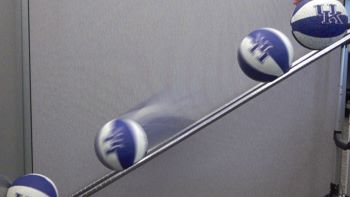
Conventional photographic imaging technologies fix the time, interval, and gain of an exposure at the instant of capture, spoiling images if these parameters are not correctly anticipated. Techniques, such as TDCI (Time-Domain Continuous Imaging) allow the integration of an image to be decoupled from the capture of scene data, creating an opportunity to not only adjust the timing and gain of an image after the fact, but manipulate those parameters in previously impossible ways. To facilitate exploration of these new dimensional freedoms, we have created NUTIK, a tool which allows scene data to be captured and computationally post-processed to expose images with user control over the time interval being sampled and the gain of integration, not just for each image rendered but for every site in each rendered image. This paper documents the design and operation of NUTIK, and makes an initial exploration of useful and interesting new photographic techniques enabled by such a tool.
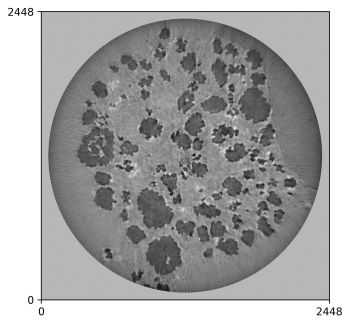
Model-Based Iterative Reconstruction (MBIR) is important because direct methods, such as Filtered Back-Projection (FBP) can introduce significant noise and artifacts in sparse-angle tomography, especially for time-evolving samples. Although MBIR produces high-quality reconstructions through prior-informed optimization, its computational cost has traditionally limited its broader adoption. In previous work, we addressed this limitation by expressing the Radon transform and its adjoint using non-uniform fast Fourier transforms (NUFFTs), reducing computational complexity relative to conventional projection-based methods. We further accelerated computation by employing a multi-GPU system for parallel processing. In this work, we further accelerate our Fourier-domain framework, by introducing four main strategies: (1) a reformulation of the MBIR forward and adjoint operators that exploits their multi-level Toeplitz structure for efficient Fourier-domain computation; (2) an improved initialization strategy that uses back-projected data filtered with a standard ramp filter as the starting estimate; (3) a hierarchical multi-resolution reconstruction approach that first solves the problem on coarse grids and progressively transitions to finer grids using Lanczos interpolation; and (4) a distributed-memory implementation using MPI that enables near-linear scaling on large high-performance computing (HPC) systems. Together, these innovations significantly reduce iteration counts, improve parallel efficiency, and make high-quality MBIR reconstruction practical for large-scale tomographic imaging. These advances open the door to near-real-time MBIR for applications such as in situ, in operando, and time-evolving experiments.
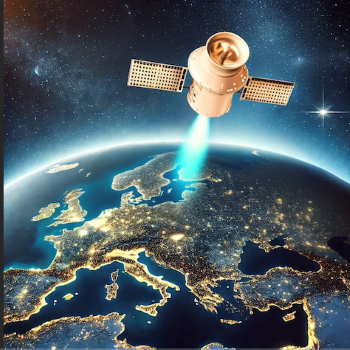
We propose a CPU-friendly knowledge distillation framework that merges the compact efficiency of MobileNetV3 with a Squeeze-and-Excitation (SE) block to create a powerful yet ultra-lightweight model for remote sensing. By blending standard cross-entropy training with softened teacher outputs, our student network gains enhanced channel attention at minimal extra overhead—only around 2.3M parameters and a 9MB on-disk size. Despite its modest footprint, it achieves competitive accuracy on representative benchmarks, including 95.24 % on UC Merced Land Use and 94.78 % on EuroSAT. This fusion of SE-driven attention and knowledge distillation addresses resource-constrained deployment scenarios (such as real-time edge inference or on-board satellite processing) where memory and compute are at a premium. Our results highlight that a streamlined, distilled architecture can approach state-of-the-art performance in aerial scene classification without sacrificing the portability essential for practical, real-world applications.