
The existing tone mapping operators (TMOs), compress either the high dynamic range (HDR) image luminance or RGB channels and assume uniform adaptation conditions, contrary to human vision that adapts colorfulness under varying adaptation luminance conditions. One of the challenges in tone mapping is maintaining perceptual consistency of both lightness and colorfulness under varying adaptation luminance. Unlike traditional approaches, this work proposes CIECAM16 lightness based, spatially adaptive tone mapping and allows colorfulness according to local adaptation luminance. Furthermore, it uses spatial white point instead of a global one aligning the human perceptual phenomenon. The paper further analyzes the performance of the proposed TMO across various spatial conditions, demonstrating that it preserves local contrast and maintains detail in both highlight and shadow regions while adaptively regulating colorfulness under various adaptation conditions. Hence, this adaptive approach for HDR to standard dynamic range (SDR) mapping offers perceptually faithful representation.

This article presents an enhanced mathematical framework that builds on the existing XCR model to more fully account for the increase in perceive display brightness as saturation rises. By integrating modifications to the CIECAM16, our toolkit allows for intuitive graphical exploration of color appearance attributes across a display’s full gamut.

A controlled experimental setup used multichannel LED lighting to create HDR scenes. Ten observers performed visual matching tasks between real illuminated scenes and HDR display content across eight lighting conditions. Jzazbz, CIECAM16, and CAM16-UCS were evaluated, analysis using STRESS metrics showed CAM16-UCS achieved the best performance for both lightness and colorfulness predictions. Based on these findings, a tone mapping operator was developed utilizing CAM16-UCS color space with local adaptation and gamma adjustments derived from experimental data. The results demonstrate that CAM16-UCS provides superior color appearance prediction for HDR content and serves as an effective foundation for tone mapping applications.

New color texture features have been designed based on second-order statistics features that are calculated from a new color co-occurrence matrix (CCM). These CCM features have three main novel design aspects. First, they incorporate perceptual color differences in their computation. Second, the second-order probability distributions are based on the CIECAM16 color appearance model and its derived Uniform Color Space (CIECAM16-UCS). Third, to avoid high-dimensional and sparse cooccurrence matrices, low-dimensional CCMs are calculated using perceptual clustering for color quantization. The ability of these new CCM metrics to analyze colored textures has been validated in two experiments using biomedical color texture images: Basal Cell Carcinoma (BCC) dermoscopic pattern detection and hemangioma depth estimation from color photographs. Both experiments demonstrated that the proposed CCM features outperformed other texture analysis methods.

Predicting the perceived brightness and lightness of image elements using color appearance models is important for the design and evaluation of HDR displays. This paper presents a series of experiments to examine perceived brightness/lightness for displayed stimuli of differing sizes. The number of observers in the first pilot experiment was 7, in the second and third pilot experiments was 6, and in the main experiment was 14. The target and test stimuli in the main experiment were 10∘ and 1∘ field of view, respectively. The results indicate a small, but consistent, effect that brightness increases with stimulus size. The effect is dependent on the stimulus lightness level but not on the hue or saturation of the stimuli. A preliminary model is also introduced to enhance models such as CIECAM16 with the capability of predicting brightness and lightness as a function of stimulus size. The proposed model yields good performance in terms of perceived brightness/lightness prediction.
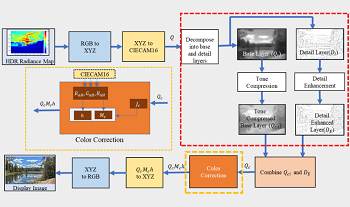
A significant challenge in tone mapping is to preserve the perceptual quality of high dynamic range (HDR) images when mapping them to standard dynamic range (SDR) displays. Most of the tone mapping operators (TMOs) compress the dynamic range without considering the surround viewing conditions such as average, dim and dark, leading to the unsatisfactory perceptual quality of the tone mapped images. To address this issue, this work focuses on utilizing CIECAM16 brightness, colorfulness, and hue perceptual correlates. The proposed model compresses the perceptual brightness and transforms the colors from HDR images using CIECAM16 color adaptations under display conditions. The brightness compression parameter was modeled via a psychophysical experiment. The proposed model was evaluated using two psychophysical experimental datasets (Rochester Institute of Technology (RIT) and Zhejiang University (ZJU) datasets).
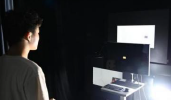
An experiment was carried out to investigate the change of color appearance for 13 surface stimuli viewed under a wide range of illuminance levels (15-32000 lux) using asymmetrical matching method. Addition to the above, in the visual field, observers viewed colours in a dark (10 lux) and a bright (200000 lux) illuminance level at the same time to simulate HDR viewing condition. The results were used to understand the relationship between the color changes under HDR conditions, to generate a corresponding color dataset and to verify color appearance model, such as CIECAM16.