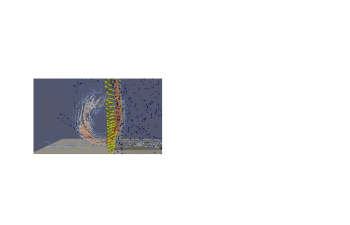
The wood-graining effect is a print defect arising from complex aerodynamic interactions within the narrow gap between printhead and substrate. Unsteady vortical structures, substrate-induced Couette flows and drop-induced entrainment destabilize jetting trajectories, leading to wavering and consolidation of printed tracks. Conventional RANS methods fail to capture these transient dynamics, necessitating high-fidelity turbulence modelling. In this study, large-eddy and detached-eddy simulations are combined with a two-way Lagrangian particle tracking framework to resolve the mutual interactions between jetted drops and surrounding gas flows. This coupling accounts for shielding, wake effects and drop-induced airflow modifications that drive cross-stream displacement. To connect droplet flight dynamics with final print quality, a wall-film model simulates spreading, coalescence and redistribution upon impact, directly linking flow-driven instabilities to visible wood-grain artifacts. The resulting CFD-Lagrangian-film framework provides a predictive description of wood-graining under realistic conditions, enabling systematic exploration of nozzle spacing, print gap and substrate speed. Demonstrated in 600 npi printheads, the study highlights how high nozzle density magnifies the impact of small aerodynamic disturbances. By establishing a physics-based understanding of wood-graining onset and evolution, the methodology supports the design of next-generation printheads and airflow control strategies to mitigate aerodynamic instabilities.