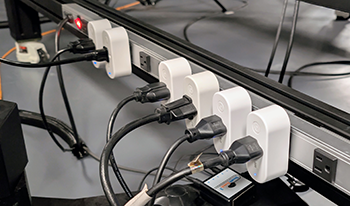
This study examines energy consumption in cultural heritage imaging systems and workflows, addressing a gap in sustainability research that has to date focused primarily on data storage infrastructure estimations. Using Home Assistant edge computing and Z-Wave smart plugs, seven distinct imaging systems were monitored over 203 hours, capturing 55,211 images, and rendering 2,448 objects. Results show an average energy requirement of 11.1 Wh per object, with an annual total of 747 kWh for digitization activities. Findings highlight opportunities to reduce energy demand and improve efficiency, such as automating continuous light shutoff and optimizing postprocessing routines that support institutional sustainability goals and provide a transparent, reproducible model for other labs and studios.

Microgrids incorporating Renewable Energy (RE) sources are being used nowadays to overcome the lack of electric power supply or grid instabilities in rural areas. Microgrids are decentralized and performant solutions to distribute electric power and to supply the consumers of a community with energy. They can be used to provide stable electrical energy to hospitals, companies and residential areas and therefore, they can contribute significantly to rural development. Based on renewable sources, they are climate neutral as well. Very often, in regular operation, a Microgrid is connected with an utility national or another distributed grid. In case of an utility grid fault occurrence, the Microgrid can still provide power since it incorporates renewable sources. However, since renewable sources like photovoltaics or wind power are volatile in supply, grid instabilities, voltage and frequency fluctuations and harmonic distortions in the Microgrid can occur. This paper focuses on developing a Microgrid (M.G.) model using MATLAB Simulink and analyzing its issues at different operational modes assuming a photovoltaic generator and a coupling to an utility grid as power sources. In order to analyze and predict the behavior of the Microgrid, deep learning methods based on Auto Regressive Moving Average (ARIMA) and Artificial Neural Networks (ANN) will be applied. It is shown that these methods allow to optimize the operation modes of the Microgrid. For instance, a balance between power supply and demand at different times could be reached and lead to economic efficiency and feasibility.