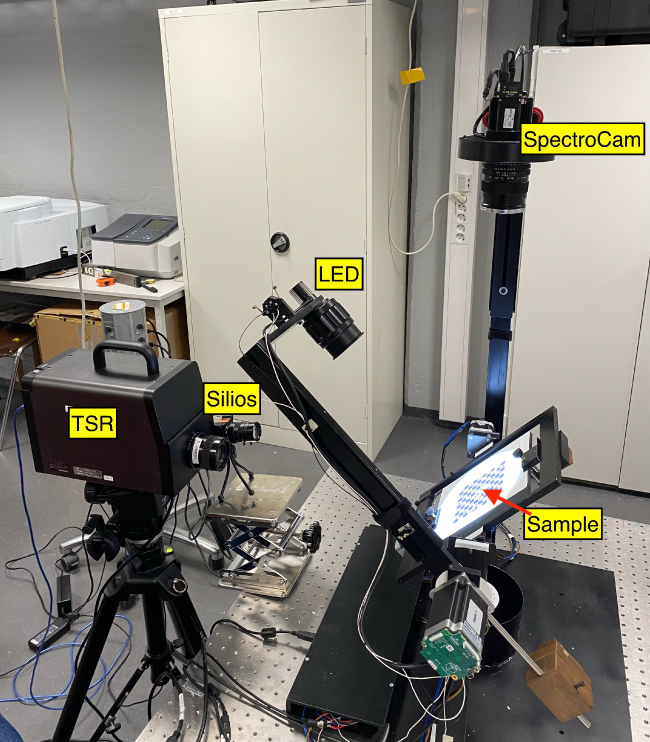
This paper presents a comprehensive experimental evaluation of spectral reconstruction methods in multispectral imaging systems, focusing on two multispectral camera technologies with differing spectral characteristics: spectral filter array and filter wheel. These systems were assessed under a controlled LED-based illumination setup. A range of reconstruction methods, encompassing both model-based and training-based approaches, were analyzed in their baseline forms as well as in adaptive configurations, which select optimal local training subsets based on spectral reflectance or camera response similarity. Experiments were conducted using a custom-built imaging setup and two well-characterized spectral reflectance datasets: the standard Munsell and the Munsell Student Color sets.
Results demonstrate that training-based methods significantly outperform model-based methods in both spectral and colorimetric accuracy. Adaptive dataset selection further enhances performance in many cases, particularly for the SpectroCam filter wheel camera. The influence of illumination on reconstruction accuracy is also examined, revealing that model-based methods are especially sensitive to the spectral power distribution of the light source. These findings offer practical and technical guidance for the design and calibration of multispectral imaging systems aimed at achieving high-accuracy spectral recovery.

It is impossible to recover the actual reflectance that induces a given colour response: as many spectra - called metamers - will integrate to the same response values. For some applications it suffices to recover a good single metamer (satisfying a criterion such that it is the smoothest amongst all metamers). However, when the same surface is viewed under different lights - generating different RGBs - the corresponding reflectances recovered by Smoothest Reflectance estimation (SR) are not all the same. Indeed, there can be a large spectral variation. Recent work has demonstrated that more stable - illuminant insensitive - metamers can be produced by Colour Corrected Smoothest Reflectance estimation (CCSR): where camera RGBs are colour corrected to a canonical reflectance light with respect to which metamers are recovered. In this paper, we examine the relationship between the spectral sensitivities of the camera and both SR and CCSR metamer recovery. Empirically, the variation in recovered metamers for the worst camera for the SR method is found to be 2.5 times larger than the best camera using CCSR. We argue that the stability of metamer recovery in general (for either SR or CCSR) is linked to the extent that accurate colour correction is possible.
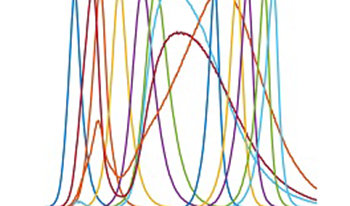
In this study, a multispectral imaging system with an RGB camera and a multichannel LED system was investigated. Firstly, it was proposed to generalize a previous method to optimize the flexible combinations of no more than three LED channels in each light source. The systems of 6-channel, 9-channel, and 12-channel were obtained, and their performances were compared with a typical 3-channel system under D65. Subsequently, the systems using single LED channels as light sources were explored. Two different methods (single-light and single-channel) were developed by selecting different numbers of the optimal lights or system channels. It was found the single-channel system outperformed the system using combined LED channels in terms of the spectral reconstruction accuracy. However, it should be noted the single-channel system required significantly more captures than the method by combining three channels in a light.