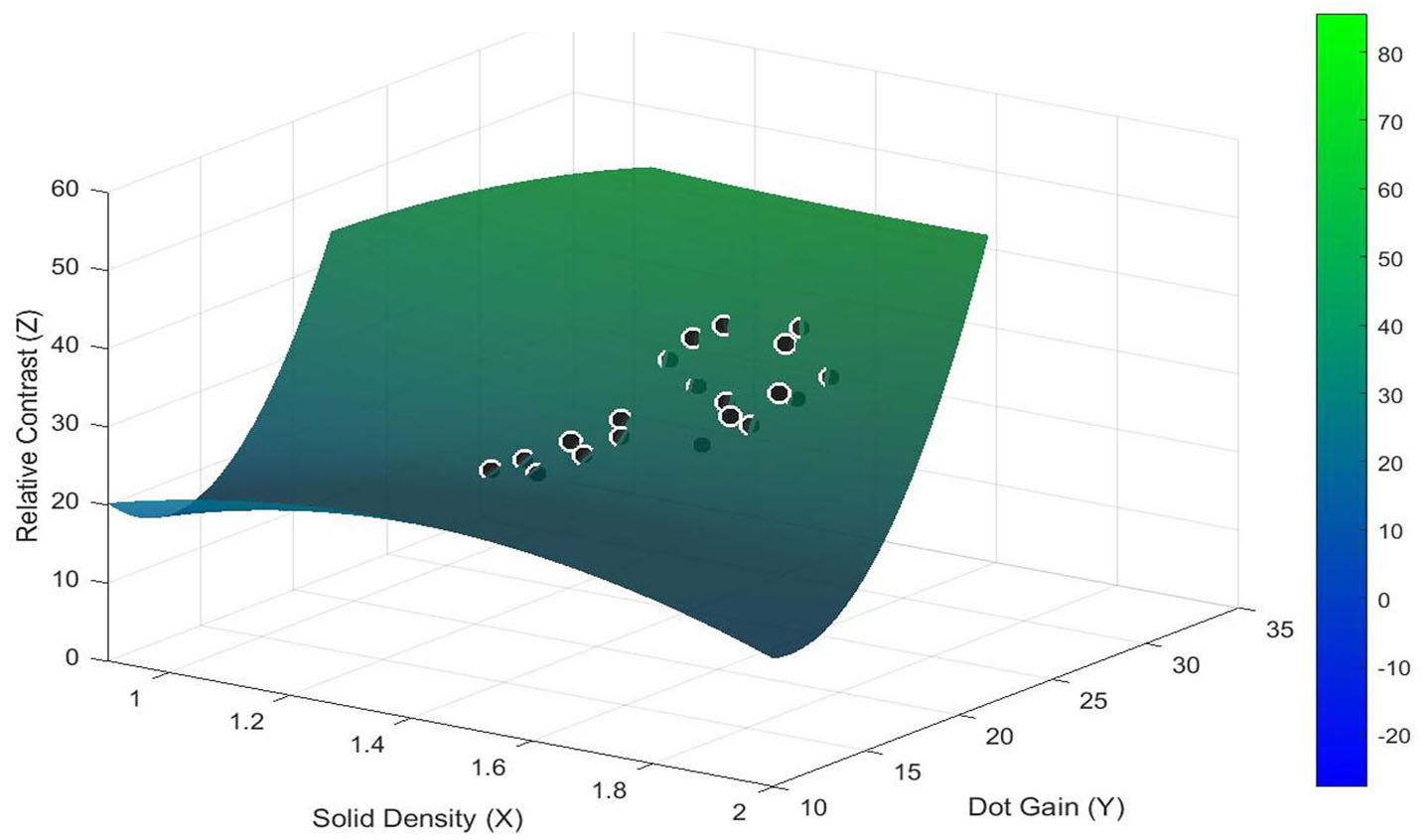
Quantitative relationships among solid density, dot gain, and relative contrast in offset printing were examined using quadratic regression modeling. By designing a scientific experimental program, 20 printed samples with fields of 50% and 75% dots were collected and accurately measured using a spectrophotometer. A quadratic regression model for four-color ink was developed using response surface analysis, emphasizing the nonlinear effects and interactions among parameters. Analysis showed all regression models achieved high significance (p < 0.001), with coefficients of determination (R2) exceeding 0.85, indicating excellent fit and predictive power. The optimal solid density parameters for the four-color inks were identified through extreme value analysis: yellow, 0.990; magenta, 1.330; cyan, 1.420; and black, 1.750, where the relative contrast peaks. These findings provide a scientific basis for optimizing offset solid density and serve as valuable guidance to improve the quality and consistency of printed materials.