Back to articles
Special issue CAPT 2025
Volume: 70 | Article ID: 030404
Image
Optimization Study of Quadratic Regression Model for Offset Solid Density
  DOI :  10.2352/J.ImagingSci.Technol.2026.70.3.030404  Published OnlineMay 2026
Abstract
Abstract

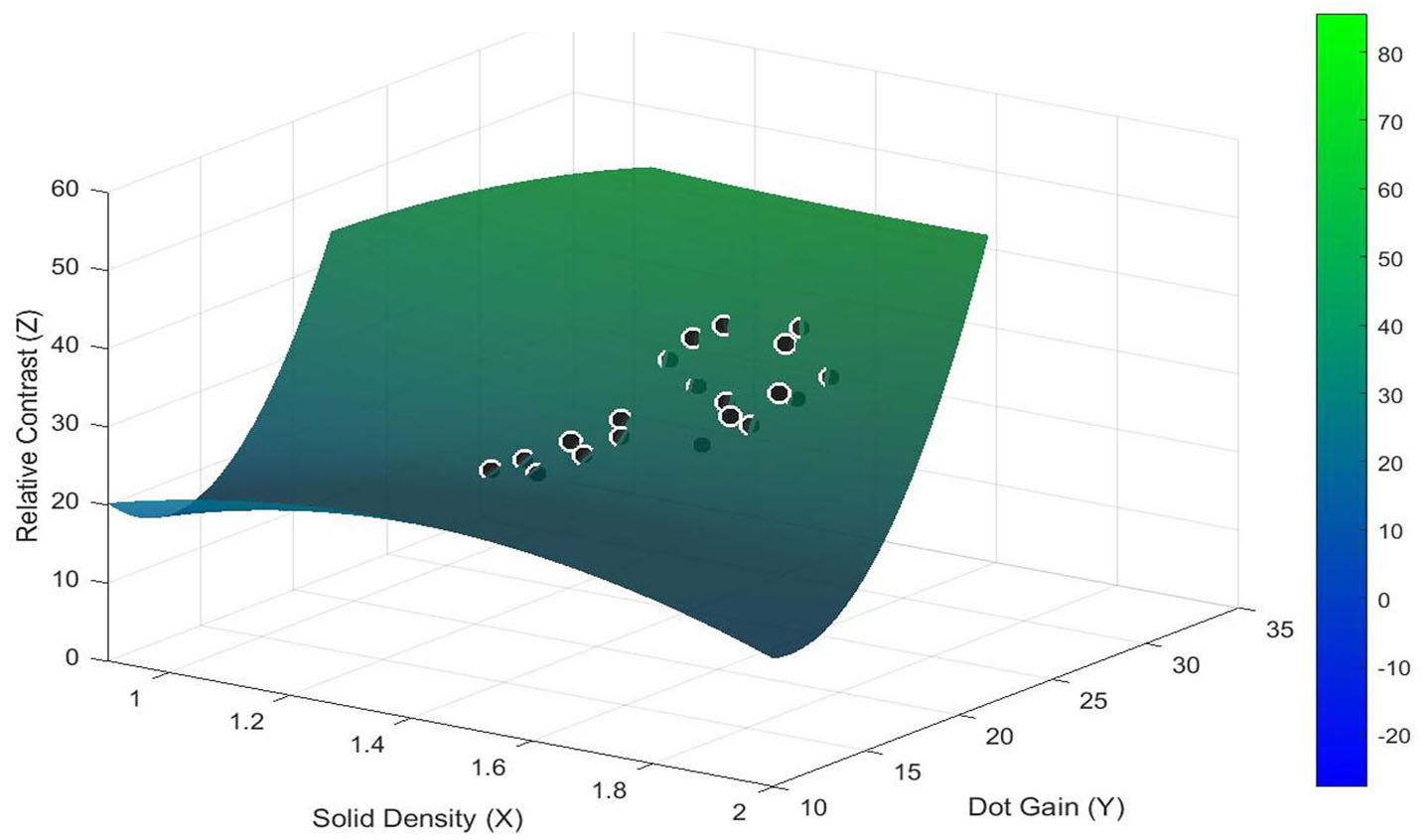
Quantitative relationships among solid density, dot gain, and relative contrast in offset printing were examined using quadratic regression modeling. By designing a scientific experimental program, 20 printed samples with fields of 50% and 75% dots were collected and accurately measured using a spectrophotometer. A quadratic regression model for four-color ink was developed using response surface analysis, emphasizing the nonlinear effects and interactions among parameters. Analysis showed all regression models achieved high significance (p < 0.001), with coefficients of determination (R2) exceeding 0.85, indicating excellent fit and predictive power. The optimal solid density parameters for the four-color inks were identified through extreme value analysis: yellow, 0.990; magenta, 1.330; cyan, 1.420; and black, 1.750, where the relative contrast peaks. These findings provide a scientific basis for optimizing offset solid density and serve as valuable guidance to improve the quality and consistency of printed materials.

Subject Areas :
Views 14
Downloads 1
 articleview.views 14
 articleview.downloads 1
  Cite this article 

Bingzhong Qiu, Xiaoli Liu, Ying-Leh Ling, Jishan Jia, Hailing Liu, "Optimization Study of Quadratic Regression Model for Offset Solid Densityin Journal of Imaging Science and Technology,  2026,  pp 1 - 11,  https://doi.org/10.2352/J.ImagingSci.Technol.2026.70.3.030404

 Copy citation
  Copyright statement 
Copyright © Society for Imaging Science and Technology 2026
  Article timeline 
  • received June 2025
  • accepted December 2025
  • PublishedMay 2026

Preprint submitted to:
  Login or subscribe to view the content