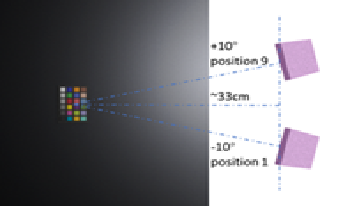
Smartphones, with their built-in cameras, are increasingly employed in clinical applications, e.g., screening patients for jaundice or anemia. In these applications, the color values of the target are converted into a biomarker using a regression or AI model. This paper investigated the accuracy and precision of x and y chromaticity values influenced by image noise and environmental factors, which could affect diagnostic performance. Accuracy was represented by the mean xy error distance (MED), and precision by the standard deviation (SD) of the xy chromaticity measurements. Using a Samsung S22 smartphone to take photos of the same color patch in 9 positions over 20°, we found that even for the same target, taking a photo from different angles caused the xy chromaticity values to change. However, the accuracy could be maintained by averaging these color measurements. The xy chromaticity measurements could also be affected by a neighboring color object and its impact on accuracy depended on the colors of the neighboring object and the target. We also investigated the scenarios with 3D graphics software Blender and found similar trends. Understanding factors influencing the accuracy and precision of color quantification can lead to improvements of smartphone imaging-based diagnostic techniques.

Video capture is becoming more and more widespread. The technical advances of consumer devices have led to improved video quality and to a variety of new use cases presented by social media and artificial intelligence applications. Device manufacturers and users alike need to be able to compare different cameras. These devices may be smartphones, automotive components, surveillance equipment, DSLRs, drones, action cameras, etc. While quality standards and measurement protocols exist for still images, there is still a need of measurement protocols for video quality. These need to include parts that are non-trivially adapted from photo protocols, particularly concerning the temporal aspects. This article presents a comprehensive hardware and software measurement protocol for the objective evaluation of the whole video acquisition and encoding pipeline, as well as its experimental validation.