 Find this author on Google Scholar
 Find this author on PubMed


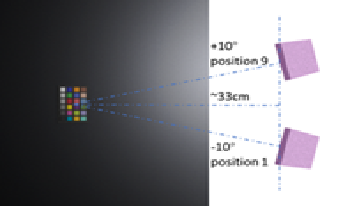
Smartphones, with their built-in cameras, are increasingly employed in clinical applications, e.g., screening patients for jaundice or anemia. In these applications, the color values of the target are converted into a biomarker using a regression or AI model. This paper investigated the accuracy and precision of x and y chromaticity values influenced by image noise and environmental factors, which could affect diagnostic performance. Accuracy was represented by the mean xy error distance (MED), and precision by the standard deviation (SD) of the xy chromaticity measurements. Using a Samsung S22 smartphone to take photos of the same color patch in 9 positions over 20°, we found that even for the same target, taking a photo from different angles caused the xy chromaticity values to change. However, the accuracy could be maintained by averaging these color measurements. The xy chromaticity measurements could also be affected by a neighboring color object and its impact on accuracy depended on the colors of the neighboring object and the target. We also investigated the scenarios with 3D graphics software Blender and found similar trends. Understanding factors influencing the accuracy and precision of color quantification can lead to improvements of smartphone imaging-based diagnostic techniques.
Yifan Zhang, Terence S. Leung, "Smartphone Color Quantification from a Clinical Perspective: Accuracy and Precision" in Color and Imaging Conference, 2025, pp 167 - 172, https://doi.org/10.2352/CIC.2025.33.1.32