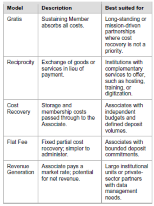
Digital preservation infrastructure remains unevenly accessible, with participation often constrained by institutional size, funding, and technical capacity. This paper presents a case study of the Academic Preservation Trust (APTrust), a community-governed digital preservation consortium, and examines how its Associate Member model functions as an incremental mechanism for broadening participation. Through sponsorship-based membership and shared governance, APTrust enables a wider range of organizations to engage in preservation activities without requiring full institutional equivalence. Drawing on early implementation experience, member census data, and the APTrust Associate Member Toolkit, this paper analyzes both the benefits and limitations of this approach, with particular attention to governance design, organizational readiness, and the distribution of risk and responsibility across member institutions.

The history of cartography has been marked by the endless search for the perfect form for the representation of the information on a spherical surface manifold into the flat planar format of the printed page or computer screen. Dozens of cartographic formats have been proposed over the centuries from ancient Greek times to the present. This is an issue not just for the mapping of the globe, but in all fields of science where spherical entities are found. The perceptual and representational advantages and drawbacks of many of these formats are considered, particularly in the tension between a unified representation, which is always distorted in some dimension, and a minimally distorted representation, which can only be obtained by segmentation into sectorial patches. The use of these same formats for the mapping of spherical manifolds are evaluated, from quantum physics through the mapping of the brain to the large-scale representation of the cosmos.