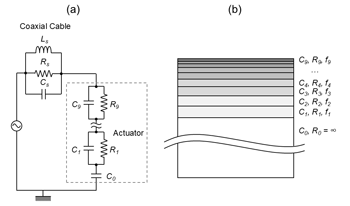
RISO Technologies, formerly Toshiba Tec’s Inkjet Business Unit, continues to provide high-quality shear-mode piezoelectric printhead products to the industrial inkjet printing market since 2001. A non-destructive method has been developed to evaluate piezoelectric actuators by simple LCR measurement. With empirical equivalent circuit modeling, we demonstrate that the approach may provide an insight into the actuator’s physical thickness in a finished printhead product and can be used as an alternative method to assess the effectiveness of the precision manufacturing processes by determining dimensional variance.
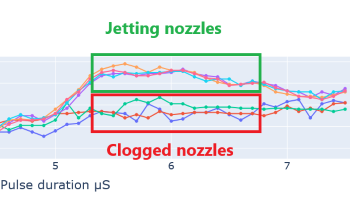
The demand for inkjet printing continues to grow across industries, driven by its flexibility and ability to deliver high-quality output at high speeds. However, ensuring reliability remains a challenge, as nozzle performance is affected by multiple factors such as ink properties, mechanical integrity, and electrical stability. Failures at the nozzle level, even if localized, can significantly compromise print quality. Printheads driven by analog waveforms have traditionally offered more flexibility and lower internal complexity, which makes them more accessible for the implementation of sensing techniques. By contrast, digital printheads, while advantageous for standardization and integration, require the development of new sensing methods and advanced algorithms to extract, process, and classify nozzle information. This work demonstrates novel approaches for real-time nozzle monitoring in digital printheads. By analyzing variations in the electrical and acoustic signatures of the nozzles, it becomes possible to identify a wide range of failure modes such as air entrapment, electrical malfunction, or mechanical degradation. The capability to detect and classify nozzle states opens new opportunities for predictive maintenance, reduced downtime, and improved reliability and print quality.