
Differences between the human visual system and RGB cameras create challenges for the color-accurate reproduction of cultural heritage materials. Spectral imaging techniques can address these challenges but often require specialized equipment, training, and software, which can make implementation difficult. The purpose of Beyond RGB is to lower the barrier to entry by providing free, open-source, and user-friendly software for processing spectral imaging. Users input sets of 6-channel images formed from pairs of RGB images captured with a standard camera under two different conditions. Outputs include a color-managed TIFF, interactive spectral reflectance estimation for regions of interest, and reports detailing accuracy and performance. Version 2.5 of the software includes changes to the processing pipeline, new features, and improved usability and visualizations.
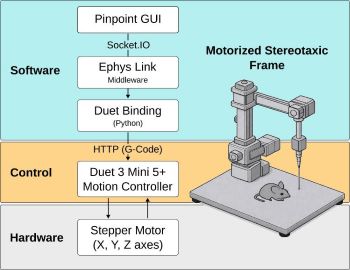
Stereotaxic neurosurgery in small-animal neuroscience remains largely manual and operator-dependent, introducing variability that compromises experimental reproducibility. This paper presents a modular retrofit system that motorises a conventional rodent stereotaxic frame and integrates it with Pinpoint for neuroanatomic positioning via a custom Ephys Link binding, enabling direct software-to-hardware coordinate translation from neuroanatomical atlas-based planning to physical needle insertion. The system uses NEMA 17 stepper motors with a 14:1 planetary gearbox, a Duet 3 Mini 5+ motion controller originally developed for open-source 3D printing and here adapted for neuroscience through developer collaboration, and RepRapFirmware configured in CNC mode. A custom firmware parameter (M203 I0.1) unlocks a minimum feed rate of 0.1 mm/min for tissue-safe brain insertion. The microinjection axis is fully automated for suction and retraction. A custom housing provides structural rigidity, vibration damping, and cable management without modifying the original frame. The system achieves positional accuracy beyond 0.1mm, with a nominal microstep increment of 0.09μm, validated using phantoms and ex vivo specimens
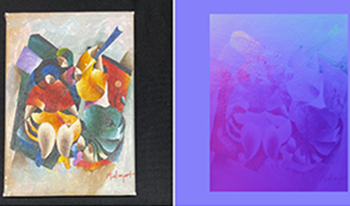
In this paper we introduce MISHA3D, a set of tools that enable 3D surface capture using the MISHA multispectral imaging system. MISHA3D uses a novel multispectral photometric stereo algorithm to estimate normal, height, and RGB albedo maps as part of the standard multispectral imaging workflow. The maps can be visualized and analyzed directly, or rendered as realistic, interactive digital surrogates using standard graphics APIs. Our hope is that these tools will significantly increase the usefulness of the MISHA system for librarians, curators, and scholars studying historical and cultural heritage artifacts.