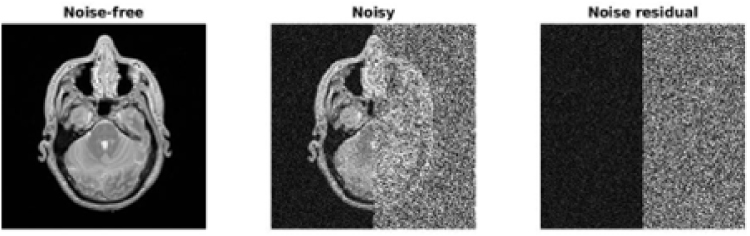
In this paper, the authors propose a new method for the denoising of magnetic resonance imaging (MRI) corrupted by noise with spatially varying noise levels. The dual-tree complex wavelet transform (DTCWT) is selected instead of the scalar wavelet transform because the DTCWT has the shift-invariant property, which is very useful in image denoising. The noise levels are estimated locally from MRI images by the DTCWT, which can be computed as a 2D matrix from the finest high-frequency subband. The k-means is used to segment the image into different regions with similar noise levels, and then denoising is performed for every region with block matching and 3D filtering (BM3D). The denoised regions are combined together and the boundary is smoothed so that better denoised image can be obtained. Experiments demonstrate that this new method outperforms several existing image denoising methods such as wiener2 filter, wavelet denoising, bivariate wavelet shrinkage, SURELET, non-local means, and BM3D even if the noise levels vary spatially.

Diffusion tensor imaging (DTI) is a non-invasive magnetic resonance imaging (MRI) modality used to map white matter fiber tracts for a variety of clinical applications; one of which is aiding preoperative assessments for tumor patients. DTI requires numerical computations on multiple diffusion weighted images to calculate diffusion tensors at each voxel and probabilistic tracking<sup>1</sup> to construct fiber tracts, or tractography. Greater accuracy in tractography is possible with larger, more advanced imaging and reconstruction algorithms. However, larger scans and advanced reconstruction is often computationally intensive. The post-processing pipeline involves significant computational resources and time and requires up to 40 minutes of computation time on state-of-the-art hardware. Parallel GPU computations can improve time for the resource-intensive tractography. A collaborative team from DIPY, NVIDIA, and UCSF recently developed a tool, GPUStreamlines, for GPU-enabled tractography<sup>2</sup> which has been expanded to support the constant solid angle (CSA) reconstruction algorithm<sup>3</sup>. This GPU-enabled tractography was applied to MRIs of brains with and without presence of lesions, with substantial increases in processing speed. We demonstrate that CSA GPU-enabled tractography in normal controls and patients are comparable to the existing gold standard tractography currently in place at UCSF.