Back to articles
Regular Article
Volume: 70 | Article ID: 020508
Image
Adaptive BM3D-based MRI Denoising with Spatially Varying Noise Levels
  DOI :  10.2352/J.ImagingSci.Technol.2026.70.2.020508  Published OnlineMarch 2026
Abstract
Abstract

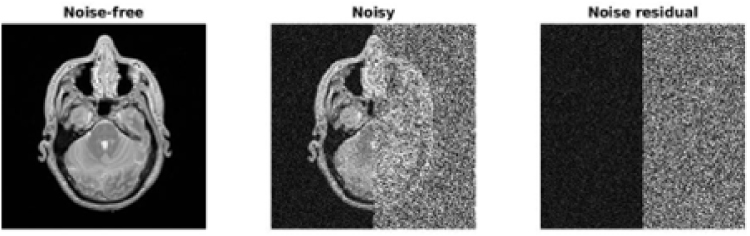
In this paper, the authors propose a new method for the denoising of magnetic resonance imaging (MRI) corrupted by noise with spatially varying noise levels. The dual-tree complex wavelet transform (DTCWT) is selected instead of the scalar wavelet transform because the DTCWT has the shift-invariant property, which is very useful in image denoising. The noise levels are estimated locally from MRI images by the DTCWT, which can be computed as a 2D matrix from the finest high-frequency subband. The k-means is used to segment the image into different regions with similar noise levels, and then denoising is performed for every region with block matching and 3D filtering (BM3D). The denoised regions are combined together and the boundary is smoothed so that better denoised image can be obtained. Experiments demonstrate that this new method outperforms several existing image denoising methods such as wiener2 filter, wavelet denoising, bivariate wavelet shrinkage, SURELET, non-local means, and BM3D even if the noise levels vary spatially.

Subject Areas :
Views 16
Downloads 1
 articleview.views 16
 articleview.downloads 1
  Cite this article 

Guang Yi Chen, Adam Krzyzak, Hong Ran Xu, "Adaptive BM3D-based MRI Denoising with Spatially Varying Noise Levelsin Journal of Imaging Science and Technology,  2026,  pp 1 - 8,  https://doi.org/10.2352/J.ImagingSci.Technol.2026.70.2.020508

 Copy citation
  Copyright statement 
Copyright © Society for Imaging Science and Technology 2026
  Article timeline 
  • received January 2025
  • accepted November 2025
  • PublishedMarch 2026

Preprint submitted to:
  Login or subscribe to view the content