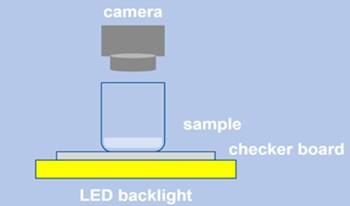
This study focuses on exploring the relationship between haze and the intrinsic optical properties of translucent materials through image-based measurements conducted in a real-world setting. The research adopts water-based samples mixed with milk and black tea, enabling the investigation of materials with varying absorption and scattering properties. We quantify haze using an image-based measurement system and estimate lateral attenuation coefficient with a translucency meter device. A linear regression model was established, relating haze to the logarithm of the product of sample thickness and the effective lateral attenuation coefficient. This finding contributes to advancing the understanding the appearance of translucent materials and has potential industrial applications.
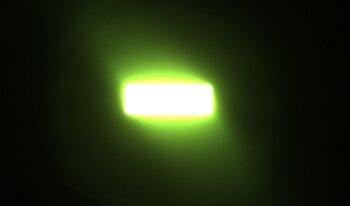
Nowadays, industrial gloss evaluation is mostly limited to the specular gloss meter, focusing on a single attribute of surface gloss. The correlation of such meters with the human gloss appraisal is thus rather weak. Although more advanced image-based gloss meters have become available, their application is typically restricted to niche industries due to the high cost and complexity. This paper extends a previous design of a comprehensive and affordable image-based gloss meter (iGM) for the determination of each of the five main attributes of surface gloss (specular gloss, DOI, haze, contrast and surface-uniformity gloss). Together with an extensive introduction on surface gloss and its evaluation, the iGM design is described and some of its capabilities and opportunities are illustrated.