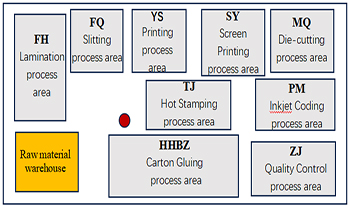
In the printing and packaging industry, highly discrete production processes often result in serious material congestion in turnover areas. Inefficient workshop layouts hinder the smooth flow of materials, forming a key bottleneck to production efficiency. To address this, the authors propose a Systematic Layout Planning (SLP) method that integrates data-driven analysis with a genetic algorithm to optimize workshop layout for printing and packaging enterprises. The proposed method first builds a logistics intensity classification system based on traditional SLP principles, considering both logistics and non-logistics relationships between processing areas. Key parameters such as equipment capacity and material-handling frequency are incorporated to generate an initial layout. A multi-objective mathematical model is then established to minimize logistics costs and maximize non-logistics relations. A genetic algorithm is applied to iteratively optimize the layout using a fitness function that evaluates both logistics path lengths and relational proximity, with crossover and mutation strategies used to balance competing objectives. A case study of a representative printing and packaging enterprise demonstrates the effectiveness of the approach. The optimized layout reduces logistics costs by 28.15% and improves non-logistics coordination by 63%. Plant Simulation validates an 11.06% increase in production capacity and enhanced system flexibility. Compared with conventional experience-based layout methods, this approach integrates production data and evolutionary optimization, offering a data-driven solution to improve layout clarity and system adaptability in the printing and packaging sector.

Abstract The real world abounds with textured surfaces. Texture-based object segmentation is one of the early steps towards identification of surfaces and objects in an image. In this article, a feature-based segmentation (FBS) method is provided to isolate objects that consist of similar texture patterns from an image based on the following features: inverse difference moment of gray-level co-occurrence matrix, contrast of Tamura, and gradient. In this article, a genetic algorithm is also provided to decide the most suitable values of the parameters used in the FBS method. The experimental results show that the FBS method can provide expressive segmentation results.