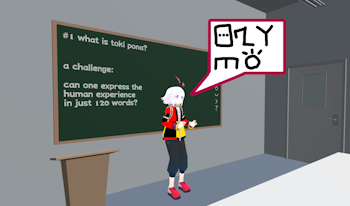
Monolingual learners frequently encounter barriers to language acquisition ranging from financial constraints to a lack of situational confidence. Virtual Reality (VR) offers a promising solution by providing a ”safe” digital environment for immersive learning experiences. This paper evaluates a comparative study between two distinct delivery methods of a language lecture within VR: a traditional video presentation and a 3D-modeled experience utilizing consumer-grade motion capture hardware. In addition, this paper provides a solution with cheap consumer motion capture hardware, addressing the financial block above, to create educational content. Overall, results were mixed; while both the video and motion capture versions yielded positive engagement, the video format demonstrated a more significant quantitative increase in results. As part of the evaluation, we analyze the performance of low-cost motion capture in educational content creation and propose design iterations to better isolate the variables influencing these learning gains.