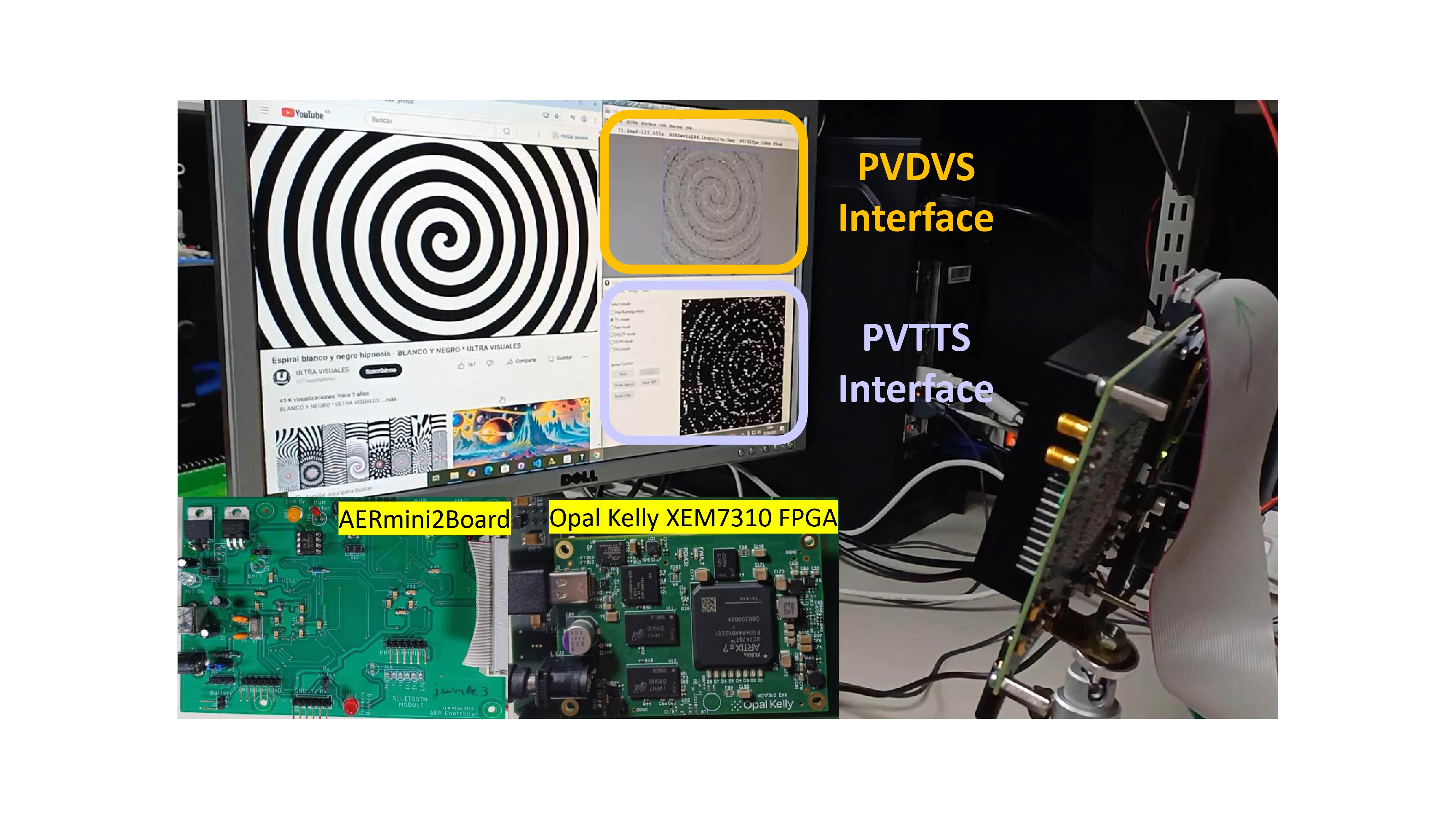
Asynchronous Time-Based Image Sensors (ATIS) jointly perform event-driven temporal contrast detection and local exposure measurement, reducing throughput by reporting only relevant information with high temporal resolution. We introduce PVATIS, a new pixel front-end that replaces the conventional pair of reverse-biased photodiodes plus a logarithmic receptor with a single diode operated in photovoltaic mode. In open-circuit, this diode simultaneously serves as the photodetector and provides logarithmic compression in a self-biased configuration. The approach directly tackles pixel-level constraints, such as pixel pitch, noise, and energy, while trading off bandwidth due to increased integrated capacitance. PVATIS is therefore a strong candidate for high-resolution, HDR, low-noise, and energy-efficient operation, particularly suitable for 3D-stacked implementations and moderate-speed imaging.

Practical video analytics systems that are deployed in bandwidth constrained environments like autonomous vehicles perform computer vision tasks such as face detection and recognition. In an end-to-end face analytics system, inputs are first compressed using popular video codecs like HEVC and then passed onto modules that perform face detection, alignment, and recognition sequentially. Previously, the modules of these systems have been evaluated independently using task-specific imbalanced datasets that can misconstrue performance estimates. In this paper, we perform a thorough end-to-end evaluation of a face analytics system using a driving-specific dataset, which enables meaningful interpretations. We demonstrate how independent task evaluations and dataset imbalances can overestimate system performance. We propose strategies to balance the evaluation dataset and to make its annotations consistent across multiple analytics tasks and scenarios. We then evaluate the end-to-end system performance sequentially to account for task interdependencies. Our experiments show that our approach provides a true estimate of the end-to-end performance for critical real-world systems.