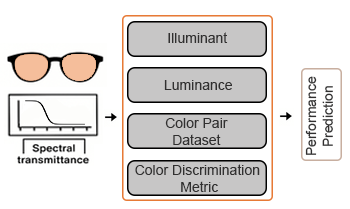
Tinted eyewear acts as a wavelength-dependent spectral filter in the visual chain and can alter both perceived color appearance and color discrimination, yet its perceptual impact is typically assessed only through physical transmittance or task-specific criteria. This paper proposes a theoretical and computational framework for evaluating tinted eyewear by integrating spectral transmittance with illumination spectra and luminance level. Color appearance changes are predicted using CIECAM16 attributes and bin-based gamut visualizations derived from the TM-30 Color Evaluation Samples, while discrimination performance is assessed for both small and large color differences and validated against behavioral data from two psychophysical experiments. Comparisons among CAM16-UCS color differences, CIEDE2000, HyAB, and cone-contrast metrics show that appearance-based measures effectively describe global color appearance changes, whereas cone-contrast–based metrics exhibit the strongest correspondence with behavioral discrimination performance. The framework provides a perceptually grounded basis for evaluating and comparing tinted eyewear across applications where both color appearance and visual performance are critical.
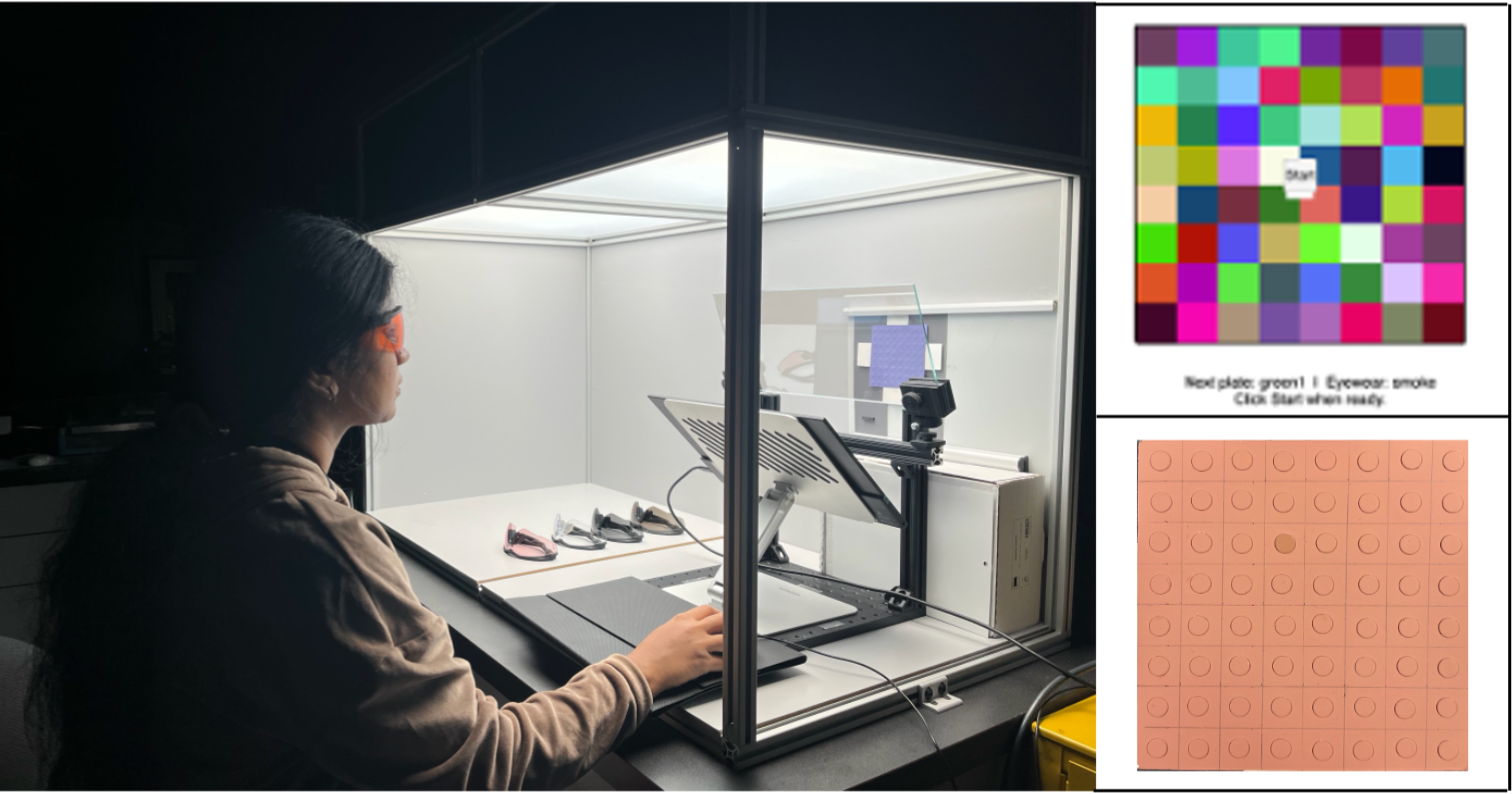
Tinted eyewear alters the spectral information reaching the human eye, potentially influencing visual performance in real-world tasks. Our previous work quantified changes in color discrimination ability under tinted eyewear using a psychophysical experiment. The present study extends this investigation by employing a visual search method to evaluate perceptual sensitivity. Two psychophysical experiments were conducted to evaluate visual performance under tinted eyewear: one focused on small color difference, assessed by reaction time and accuracy of target detection, and the other on large color differences, evaluating discrimination ability with increasing viewing distance. Overall, the results suggest that color appearance–based evaluations may help account for variations in task performance under tinted eyewear, particularly for small color difference stimuli. For large color difference stimuli, performance difference caused by tinted eyewear were observed, but the relationship between prediction and performance was not clear, which needs future investigation. By comparing the experimental data with model predictions, this study aims to provide a deeper understanding of the perceptual behavior changes caused by tinted eyewear.

This research explores the effect of various eyewear lenses, designed with varied transmittance properties, on human visual perception. These lenses are developed to enhance contrast for spatial-chromatic patterns like cyan-red (CR) and magenta-green (MG) compared to lenses with more uniform transmittance. The study evaluates participants’ accuracy and response times in identifying contrast patterns, aiming to understand how different eyewear configurations affect these visual metrics. Two experiments were conducted: the first adjusted spatial frequencies to determine visibility thresholds with different eyewear, while the second utilized a 4-alternative forced-choice (4-AFC) method to measure participants’ ability to identify contrast patterns. Results indicate that eyewear with varied transmittance enhances contrast sensitivity for these chromatic pairs more effectively than uniform transmittance lenses, offering valuable insights into optimizing color-enhancing eyewear for improving certain aspects of visual performance and providing broader applications in enhancing human visual perception across various visual tasks.