 Find this author on Google Scholar
 Find this author on PubMed


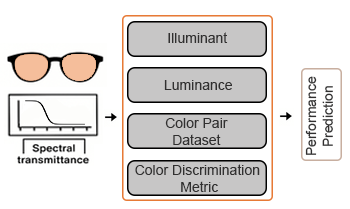
Tinted eyewear acts as a wavelength-dependent spectral filter in the visual chain and can alter both perceived color appearance and color discrimination, yet its perceptual impact is typically assessed only through physical transmittance or task-specific criteria. This paper proposes a theoretical and computational framework for evaluating tinted eyewear by integrating spectral transmittance with illumination spectra and luminance level. Color appearance changes are predicted using CIECAM16 attributes and bin-based gamut visualizations derived from the TM-30 Color Evaluation Samples, while discrimination performance is assessed for both small and large color differences and validated against behavioral data from two psychophysical experiments. Comparisons among CAM16-UCS color differences, CIEDE2000, HyAB, and cone-contrast metrics show that appearance-based measures effectively describe global color appearance changes, whereas cone-contrast–based metrics exhibit the strongest correspondence with behavioral discrimination performance. The framework provides a perceptually grounded basis for evaluating and comparing tinted eyewear across applications where both color appearance and visual performance are critical.
Sanaz Aghamohammadi Kalkhoran, Shuyi Zhao, Likhitha Nagahanumaiah, Christopher Thorstenson, Susan Farnand, "Color Perception through Tinted Eyewear: Theoretical and Computational Perspective" in Electronic Imaging, 2026, pp 244-1 - 244-7, https://doi.org/10.2352/EI.2026.38.8.IQSP-244