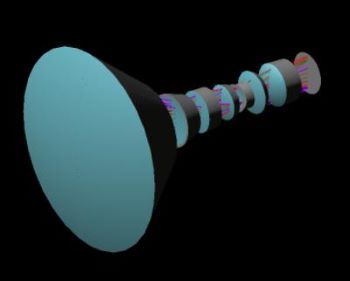
Optical system development requires software tools to design lenses, mechanical components, sensors, and image signal processing (ISP) pipelines. Historically, these tools are operated independently and do not provide insight into complete system performance. As a result, development teams often incur time and cost inefficiencies by designing, building, and testing hardware prototypes that either fail to meet requirements or significantly exceed them. Optical systems are therefore frequently over-designed in one or more areas—such as lens tolerances, sensor bit depth, or ISP complexity—to mitigate risk. End-to-end simulation offers a path to eliminate these inefficiencies and accelerate time-to-market. In this work, we simulate a complete imaging system and demonstrate a method for identifying a minimally viable solution that meets the performance requirements of an object detection application. Using the imaging system simulator ImSym, we model the full imaging chain, including lens behavior, detector characteristics and noise, ISP routines, and straylight effects. These elements are combined to generate simulated images that enable validation of system performance prior to hardware fabrication.

Auto-Valet parking is a key emerging function for Advanced Driver Assistance Systems (ADAS) enhancing traditional surround view system providing more autonomy during parking scenario. Auto-Valet parking system is typically built using multiple HW components e.g. ISP, micro-controllers, FPGAs, GPU, Ethernet/PCIe switch etc. Texas Instrument’s new Jacinto7 platform is one of industry’s highest integrated SoC replacing these components with a single TDA4VMID chip. The TDA4VMID SoC can concurrently do analytics (traditional computer vision as well as deep learning) and sophisticated 3D surround view, making it a cost effective and power optimized solution. TDA4VMID is a truly heterogeneous architecture and it can be programmed using an efficient and easy to use OpenVX based middle-ware framework to realize distribution of software components across cores. This paper explains typical functions for analytics and 3D surround view in auto-valet parking system with data-flow and its mapping to multiple cores of TDA4VMID SoC. Auto-valet parking system can be realized on TDA4VMID SOC with complete processing offloaded of host ARM to the rest of SoC cores, providing ample headroom for customers for future proofing as well as ability to add customer specific differentiation.