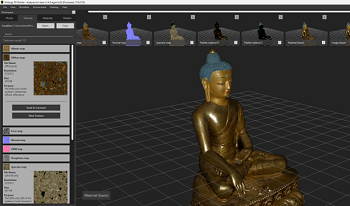
Kintsugi 3D is an emerging platform for 3D digitization and dissemination, offering empirically based appearance accuracy for objects with complex reflectance, and dynamic presentation to the public audience. Over the past two years since Kintsugi 3D’s initial release, new features have been added with a focus on giving museum professionals more control over how objects are processed and viewed. The processing tool, Kintsugi 3D Builder, now offers the capability to visualize how the software deconstructs appearance into “basis materials” and even remove unwanted materials from the list for subsequent re-processing. We are also working towards positioning our own Kintsugi 3D Viewer as a potential open-source alternative for Sketchfab. These advances have empowered heritage users at heritage institutions to effectively utilize Kintsugi 3D to enhance their digitization workflows.
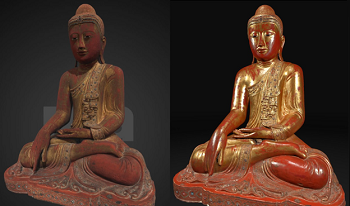
Advancements in accurate digitization of 3D objects through photogrammetry are ongoing in the cultural heritage space, for the purposes of digital archival and worldwide access. This paper outlines and documents several user-driven enhancements to the photogrammetry pipeline to improve the fidelity of digitizations. In particular, we introduce a new platform for capturing empirically-based specularity of 3D models called Kintsugi 3D, and visually compare traditional photogrammetry results with this new technique. Kintsugi 3D is a free and open-source package that features, among other things, the ability to generate a set of textures for a 3D model, including normal and specularity maps, based empirically on ground-truth observations from a flash-on-camera image set. It is hoped that the ongoing development of Kintsugi 3D will improve public access for institutions with an interest in sharing high-fidelity photogrammetry.