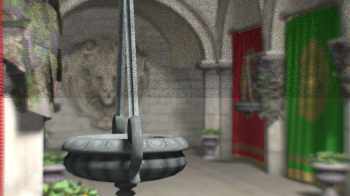
Raytracing in combination with Monte Carlo simulation is an accurate method to simulate optical systems in virtual 3D scenes. Since Monte Carlo simulation relies on random sampling, many samples per pixel need to be computed for a noise-free image, resulting in high computational effort. Even the fastest ray tracers can only trace a few samples per pixel in real-time. A common solution in computer graphics is to compute the image with a few samples per pixel and apply a Monte Carlo denoiser to remove the noise. Since the denoiser alters the image, the question arises to what extent this influences the quality of the simulation. Utilizing “Simulating tests to test simulation”, we measure the SFR curve of a simulation denoised with the NVIDIA OptiX Denoiser and compare it with a highly sampled baseline simulation. Although the image is altered by denoising, using denoised ray tracing simulations yields more realistic results for real-time rendering than a Gaussian blur, but there is a significant texture loss.

This paper presents the design of an accurate rain model for the commercially-available Anyverse automotive simulation environment. The model incorporates the physical properties of rain and a process to validate the model against real rain is proposed. Due to the high computational complexity of path tracing through a particle-based model, a second more computationally efficient model is also proposed. For the second model, the rain is modeled using a combination of a particle-based model and an attenuation field. The attenuation field is fine-tuned against the particle-only model to minimize the difference between the models.