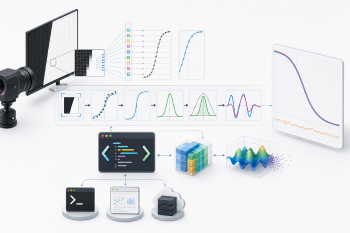
ISO 12233 defines the slanted-edge technique for estimating the spatial frequency response (SFR) of imaging systems. SFRMAT, originally developed by Burns, has served for over two decades as the de facto MATLAB implementation of this standard. This paper presents a fully open-source Python implementation of SFRMAT5 with equivalent functionality and numerical fidelity. The software mirrors the original MATLAB structure to simplify maintenance and coexistence, while supporting CLI, GUI, and headless operation. Validation against the MATLAB version demonstrates practical numerical equivalence (< 10−10) on real captures where valid outputs are available. The implementation enables broader adoption in research, education, and production imaging pipelines and is available at burnsdigitalimaging. com/ software/ sfrmat .
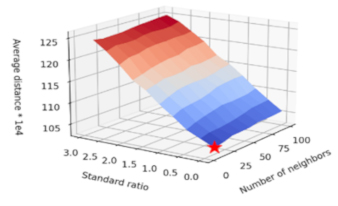
Point clouds generated from 3D scans of part surfaces consist of discrete 3D points, some of which may be incorrect, or outliers. Outlier points can be caused by the scanning method, part surface attributes, and data acquisition techniques. Filtering techniques to remove these outliers from point clouds frequently require a “guess and check” method to determine proper filter parameters. This paper presents two novel approaches to automatically determine proper filter parameters using the relationships among point cloud outlier removal, principal component variance, and the average nearest neighbor distance. Two post-processing workflows were developed that reduce outlier frequency in point clouds using these relationships. These post-processing workflows were applied to point clouds with artificially generated noise and outliers along with two real-world point clouds. Analysis of the results showed both approaches effectively reducing outlier frequency when used in suitable circumstances.