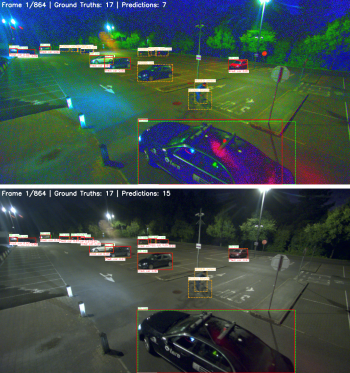
Image signal processors in automotive cameras are typically tuned for human visual perception, yet these same cameras increasingly serve as the primary input to safety-critical object detection systems. In this study, we evaluate the sensitivity of object detection to ISP parameter variation under nighttime conditions. We process raw Bayer data from the nighttime subset of the G-MIND dataset through 21 ISP configurations spanning gain, gamma correction, saturation, bilateral noise filtering, and edge enhancement, and additionally test raw Bayer input with and without gamma correction. For each configuration, we fine-tune four detector architectures representing three design families (single-stage CNN, two-stage CNN, and transformer-based), yielding 92 models evaluated using mAP50−95 per class across five distance bins from 0 to 75 metres. Gamma and gain have negligible effects when models are retrained. Saturation is the most critical parameter: YOLOv8m loses 26.2 mAP points across the saturation range while Faster R-CNN loses only 2.2. Raw Bayer input performs on par with the default ISP for single-stage detectors while eliminating all ISP processing cost, suggesting that a full human-tuned ISP is not optimal for nighttime machine perception. No ISP variant reverses detection degradation with distance. These findings demonstrate that ISP sensitivity is architecture-dependent, that a full human-tuned ISP is not optimal for nighttime machine perception, and that there is scope to develop leaner, perception-aware ISP pipelines tailored to the downstream detector
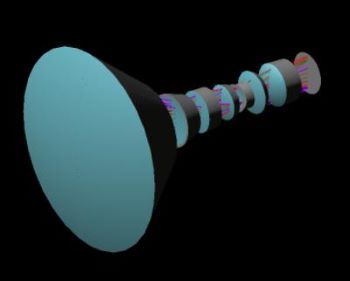
Optical system development requires software tools to design lenses, mechanical components, sensors, and image signal processing (ISP) pipelines. Historically, these tools are operated independently and do not provide insight into complete system performance. As a result, development teams often incur time and cost inefficiencies by designing, building, and testing hardware prototypes that either fail to meet requirements or significantly exceed them. Optical systems are therefore frequently over-designed in one or more areas—such as lens tolerances, sensor bit depth, or ISP complexity—to mitigate risk. End-to-end simulation offers a path to eliminate these inefficiencies and accelerate time-to-market. In this work, we simulate a complete imaging system and demonstrate a method for identifying a minimally viable solution that meets the performance requirements of an object detection application. Using the imaging system simulator ImSym, we model the full imaging chain, including lens behavior, detector characteristics and noise, ISP routines, and straylight effects. These elements are combined to generate simulated images that enable validation of system performance prior to hardware fabrication.

In autonomous driving applications, cameras are a vital sensor as they can provide structural, semantic and navigational information about the environment of the vehicle. While image quality is a concept well understood for human viewing applications, its definition for computer vision is not well defined. This gives rise to the fact that, for systems in which human viewing and computer vision are both outputs of one video stream, historically the subjective experience for human viewing dominates over computer vision performance when it comes to tuning the image signal processor. However, the rise in prominence of autonomous driving and computer vision brings to the fore research in the area of the impact of image quality in camera-based applications. In this paper, we provide results quantifying the accuracy impact of sharpening and contrast on two image feature registration algorithms and pedestrian detection. We obtain encouraging results to illustrate the merits of tuning image signal processor parameters for vision algorithms.