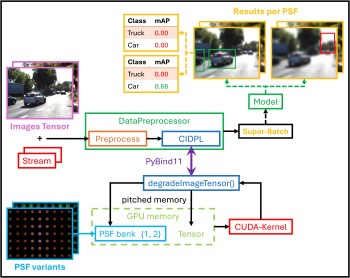
Physically grounded PSF-based image degradation is necessary for studying optics-related object-detector robustness, but existing workflows typically rely on offline dataset generation and integrate poorly with GPU-resident frameworks such as MMDetection. We present CIDPL, a CUDA-accelerated Python library that adapts our standalone Image Degradation Application (IDA) into a real-time, framework-integrated pipeline for MMDetection. CIDPL couples Python and C++ via PyBind11, performs degradation directly on GPU tensors in the DataPreprocessor, and organizes multiple optical variants in a traceable Super-Batch format. Numerical validation shows exact agreement with IDA for TIFF inputs, while optical validation reproduces KrakenOS-based SFR trends. In throughput tests, CIDPL improves mean degradation speed over IDA by 4.7x on a single GPU and 7.6x on two GPUs, enabling real-time processing at 117 FPS with negligible overhead during both training and inference. KITTI experiments further show that the integration enables practical detector-level robustness studies under varying defocus conditions.

Image classification is extensively used in various applications such as satellite imagery, autonomous driving, smartphones, and healthcare. Most of the images used to train classification models can be considered ideal, i.e., without any degradation either due to corruption of pixels in the camera sensors, sudden shake blur, or the compression of images in a specific format. In this paper, we have proposed a novel CNN-based architecture for image classification of degraded images based on intermediate layer knowledge distillation and data augmentation approach cutout named ILIAC. Our approach achieves 1.1%, and 0.4% mean accuracy improvements for all the degradation levels of JPEG and AWGN, respectively, compared to the current state-of-the-art approach. Furthermore, ILIAC method is efficient in computational capacity, i.e., about half the size of the previous state-of-the-art approach in terms of model parameters and GFlops count. Additionally, we demonstrate that we do not necessarily need a larger teacher network in knowledge distillation to improve the model performance and generalization of a smaller student network for the classification of degraded images.