 Find this author on Google Scholar
 Find this author on PubMed


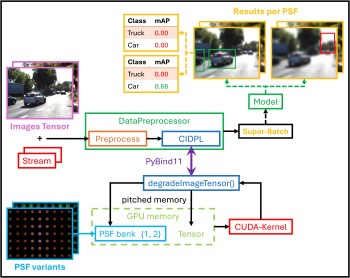
Physically grounded PSF-based image degradation is necessary for studying optics-related object-detector robustness, but existing workflows typically rely on offline dataset generation and integrate poorly with GPU-resident frameworks such as MMDetection. We present CIDPL, a CUDA-accelerated Python library that adapts our standalone Image Degradation Application (IDA) into a real-time, framework-integrated pipeline for MMDetection. CIDPL couples Python and C++ via PyBind11, performs degradation directly on GPU tensors in the DataPreprocessor, and organizes multiple optical variants in a traceable Super-Batch format. Numerical validation shows exact agreement with IDA for TIFF inputs, while optical validation reproduces KrakenOS-based SFR trends. In throughput tests, CIDPL improves mean degradation speed over IDA by 4.7x on a single GPU and 7.6x on two GPUs, enabling real-time processing at 117 FPS with negligible overhead during both training and inference. KITTI experiments further show that the integration enables practical detector-level robustness studies under varying defocus conditions.
Maximilian Dornik, Julian Barthel, Daniel Jakab, Alexander Braun, "CIDPL: A Real-time CUDA-accelerated Python-framework Simulating PSF-based Optical Artifacts Integrated in MMDetection" in Electronic Imaging, 2026, pp 104-1 - 104-8, https://doi.org/10.2352/EI.2026.38.16.AVM-104