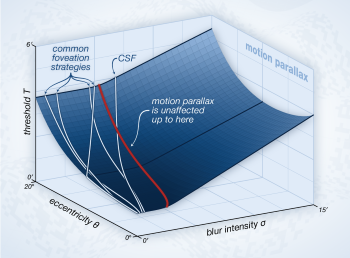
Foveated rendering is a key technique for reducing computational load in immersive display systems by lowering rendered image quality in the peripheral visual field while preserving high fidelity in the fovea. While the impact of foveation on perceived spatial detail is well understood, its influence on other visual qualities, such as depth from motion parallax, remains unclear. In this work, we investigate how foveated rendering affects motion-based depth perception across the visual field. Building on previous work on binocular disparity, we use a comparable experimental setup to isolate motion parallax as the sole depth cue and measure depth discrimination thresholds under varying levels of foveation, modeled as varying intensities of spatial blur, and eccentricity. Our results show that depth from motion is immediately impaired by visible foveation, with stronger impairments at higher levels of blur. These findings suggest that motion-based depth cues may be more sensitive to foveated rendering than disparity cues, which were previously found to be largely unaffected.
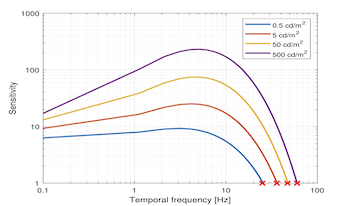
Contrast sensitivity functions (CSFs), which provide estimations of detection thresholds, have far-reaching applications in digital media processing, rendering, and transmission. There is a practical interest in obtaining accurate estimations of spatial and temporal resolution limits from a spatiotemporal CSF model. However, current spatiotemporal CSFs are inaccurate when predicting high-frequency limits such as critical flicker frequency (CFF). To address this problem, we modified two spatiotemporal CSFs, namely Barten’s CSF and stelaCSF, to better account for the contrast sensitivity at high temporal frequencies, both in the fovea and eccentricity. We trained these models using 15 datasets of spatial and temporal contrast sensitivity measurements from the literature. Our modifications account for two features observed in CFF measurement: the increase of CFF at medium eccentricities (of about 15 deg), and the saturation of CFF at high luminance values. As a result, the prediction errors for CFF obtained from the modified models improved remarkably.