 Find this author on Google Scholar
 Find this author on PubMed


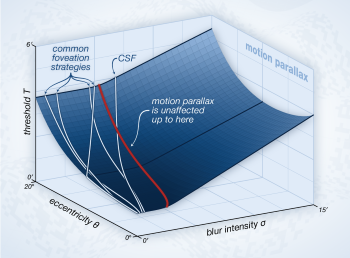
Foveated rendering is a key technique for reducing computational load in immersive display systems by lowering rendered image quality in the peripheral visual field while preserving high fidelity in the fovea. While the impact of foveation on perceived spatial detail is well understood, its influence on other visual qualities, such as depth from motion parallax, remains unclear. In this work, we investigate how foveated rendering affects motion-based depth perception across the visual field. Building on previous work on binocular disparity, we use a comparable experimental setup to isolate motion parallax as the sole depth cue and measure depth discrimination thresholds under varying levels of foveation, modeled as varying intensities of spatial blur, and eccentricity. Our results show that depth from motion is immediately impaired by visible foveation, with stronger impairments at higher levels of blur. These findings suggest that motion-based depth cues may be more sensitive to foveated rendering than disparity cues, which were previously found to be largely unaffected.
Sophie Kergaßner, Piotr Didyk, "The Impact of Blur on Motion Parallax and Binocular Disparity" in Electronic Imaging, 2026, pp 209-1 - 209-7, https://doi.org/10.2352/EI.2026.38.10.HVEI-209