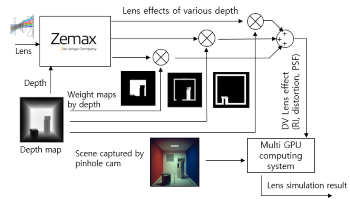
Full optical simulations of 3D scenes using commercial ray-tracing tools such as Speos provide physically accurate results but suffer from excessive computation time. To overcome this limitation, we propose a hybrid simulation pipeline that separates scene rendering and lens modeling into two stages. First, Zemax is used to precompute lens characteristics including distortion maps, depth-variant relative illumination, and a library of depth-dependent point spread functions (PSFs). Second, Speos is employed to render the ideal camera scene and per-pixel depth maps without optical degradation. Finally, a distributed multi-GPU system efficiently applies the Zemax-derived optical degradations to the Speos-rendered images. This approach significantly reduces simulation time while retaining the essential physical properties of lens degradation. The proposed framework provides realistic image formation data for testing computer vision and imaging system design.