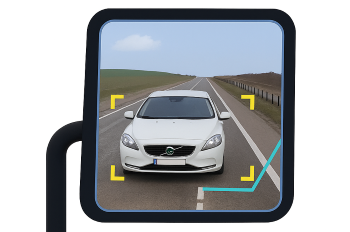
As the automotive industry becomes increasingly digitalized, Camera Monitoring Systems (CMS) are replacing traditional mirrors, offering improved aerodynamics and wider fields of view. However, depth perception remains a challenge, and unclear overlays can reduce driver trust. This study investigates how different CMS augmentations affect distance estimation during overtaking. Thirty participants viewed video clips across three road scenes using one baseline and three augmented interface concepts. They estimated vehicle distances, rated certainty, and reported preferences. The Lines concept, using distance lines and vehicle outlines, produced the most favorable results with the lowest absolute errors and highest clarity and reliability ratings, although it introduced systematic overestimation. The Corner concept led to consistent underestimation but offered some perceived benefits, while the Dashed concept performed similarly to the baseline. The final design builds on the strengths of the Lines concept, with refinements inspired by Corner to enhance visibility and stability. Recommendations include using intuitive depth cues, accessible colors, and well‑timed visual elements. Future research should explore sound cues, symbolic warnings, and long‑term user acceptance.
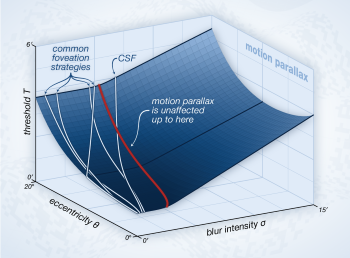
Foveated rendering is a key technique for reducing computational load in immersive display systems by lowering rendered image quality in the peripheral visual field while preserving high fidelity in the fovea. While the impact of foveation on perceived spatial detail is well understood, its influence on other visual qualities, such as depth from motion parallax, remains unclear. In this work, we investigate how foveated rendering affects motion-based depth perception across the visual field. Building on previous work on binocular disparity, we use a comparable experimental setup to isolate motion parallax as the sole depth cue and measure depth discrimination thresholds under varying levels of foveation, modeled as varying intensities of spatial blur, and eccentricity. Our results show that depth from motion is immediately impaired by visible foveation, with stronger impairments at higher levels of blur. These findings suggest that motion-based depth cues may be more sensitive to foveated rendering than disparity cues, which were previously found to be largely unaffected.