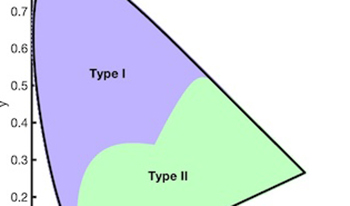
To calibrate a display, a standard color gamut is defined by the target chromaticity coordinates of RGB primaries in CIE 1931 color space, e.g. DCI-P3 and Rec.709. Due to lack of spectral information of such standard target gamut primaries, transformation of target color gamut from CIE 1931 color space to another color space associated with a different observer (defined by a different set of CMFs) is not possible. In this paper, we introduce a novel method for transforming target primary colors from CIE 1931 color space into a new target color space with improved color appearance consistency for typical observers. Our approach represents each primary with a simple spectral definition across the visible range. Results demonstrate that this spectral definition significantly reduces inter-observer variation, thereby offering a practical solution to cross-observer display color space transformation.

Designers need to specify the colors for their 3D objects in form of sRGB values, but, given the limitations of the color 3D printing process, they have no idea how those colors chosen on a screen will look once printed in 3D. In addition, HP Inc. wants to showcase the color capabilities of our 3D color printing systems in an effective way. This paper describes an aesthetically pleasing tool to effectively showcase the color capabilities of our color 3D printing systems. It is also a reference color system that enables designers 1) to select colors that are achievable with our printing systems, 2) to interactively composite color palettes for their 3D design and 3) to get the desired printed color in a time and cost-efficient way that minimizes iterations. The system itself consists of a series of subobjects where each sub-object shows how a color looks like when manufactured in different surface orientations. It can be disassembled and used for compositing color palettes for 3D objects, and it is also designed to be manufactured and cleaned fully assembled, showcasing the power of 3D printing.