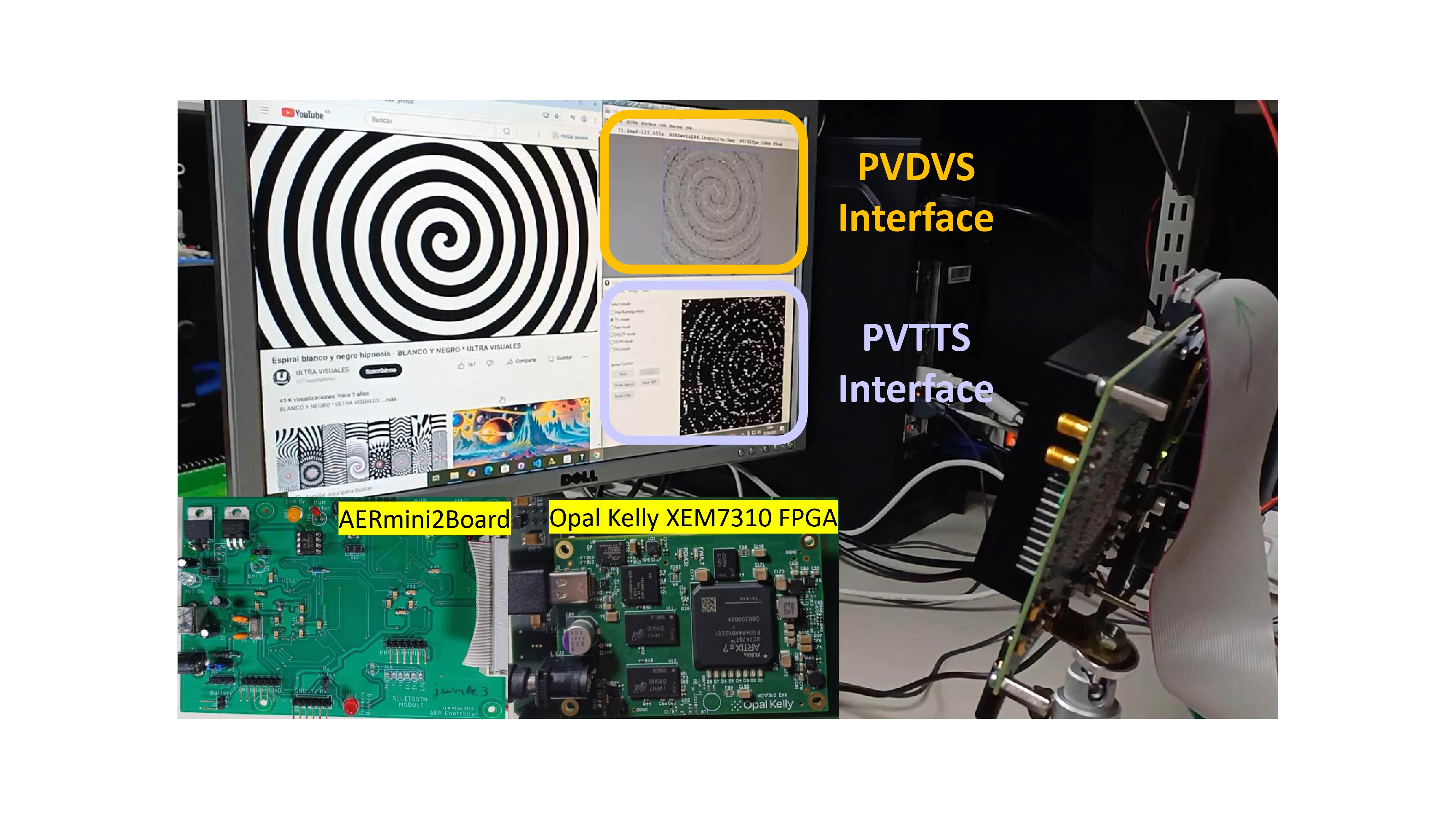
Asynchronous Time-Based Image Sensors (ATIS) jointly perform event-driven temporal contrast detection and local exposure measurement, reducing throughput by reporting only relevant information with high temporal resolution. We introduce PVATIS, a new pixel front-end that replaces the conventional pair of reverse-biased photodiodes plus a logarithmic receptor with a single diode operated in photovoltaic mode. In open-circuit, this diode simultaneously serves as the photodetector and provides logarithmic compression in a self-biased configuration. The approach directly tackles pixel-level constraints, such as pixel pitch, noise, and energy, while trading off bandwidth due to increased integrated capacitance. PVATIS is therefore a strong candidate for high-resolution, HDR, low-noise, and energy-efficient operation, particularly suitable for 3D-stacked implementations and moderate-speed imaging.

We report a sun tracker sensor for attitude control of space navigation systems. The sensor exploits the concept of asynchronous operation previously devised by the authors for those devices. Asynchronous luminance sensors optimize sun trackers operation because only illuminated pixels are readout and can transmit data. This approach outperforms classic frame-based sun trackers in terms of bandwidth consumption, latency, and power consumption. The new sensor under study has been optimized for operation and interaction with other attitude control systems when it is embarked. The sensor power consumption is quite reduced. To save power, its pixels enter automatically in standby mode after gauging illumination levels. The device operates with only 0.45V. The pixel matrix has been devised to optionally be directly powered by energy harvesting systems based on photovoltaic diodes connected to a storage capacitor without a DC-DC converter.