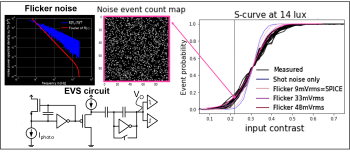
Event-based vision sensors (EVS) are gaining interest in applications requiring low latency, high dynamic range, and energy-efficient imaging, such as image deblurring, object detection for autonomous vehicles, and AR/VR glasses. Unlike conventional frame-based sensors, their performance is highly sensitive to device-level noise processes, especially in low-light scenes. In previous work, we proposed a framework for pixel-wise parameter estimation for EVS characterization. We introduced a physics-based model and a shot noise model and validated them on a typical pixel setup. However, that model did not explicitly account for flicker noise, despite its being one of the major noise sources in modern CMOS technologies—a key factor behind pixel-to-pixel variability and spurious "noisy pixels," whose strength depends strongly on the technology. In this paper, we introduce a dedicated flicker-noise component into the previously developed EVS simulator. We calibrated the circuit flicker noise model using circuit-level simulations and sensor measurements, achieving an error margin of less than 20%. The resulting model reproduces EVS circuit noise statistics and generates realistic synthetic event streams. The results indicated that flicker noise was larger than the value expected from SPICE simulation by a factor of five. Our work enables circuit-level trade-off studies and offers intuitive noise visualizations for both hardware designers and algorithm developers to assess algorithmic impact.

Correlated Multiple Sampling (CMS), which is an extension of Correlated Double Sampling (CDS), is a very popular noise reduction technique used in the readout chain of image sensors. It has been analyzed in the literature, showing that, with an increasingly number M of samples, the total noise tends to a limit value dominated by the pixel 1/f noise. Nevertheless, this approach fails to explain why, in some cases, the total noise measurement may reach a minimum before, against all odds, finally growing with M. This paper shows that an explanation can be found if the pixel noise Power Spectral Density (PSD) varies in 1/fE with a frequency exponent E > 1 instead of E=1.