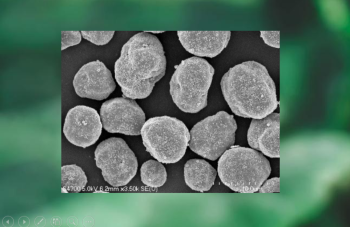
Toner technology is at a transformative crossroads. With heightened demands for vivid print quality, sustainability, and cost-efficient manufacturing, Xerox has reimagined its toner development pipeline. This paper presents a comprehensive overview of Xerox’s innovative work in three pillars: (1) specialty toners enabling new color and functional effects, (2) sustainable toners incorporating bio-based and low-impact materials, and (3) advanced manufacturing via the Continuous Emulsion Aggregation (EA) toner process, with new solvent-free techniques for resin emulsification. Together, these advances push the boundaries of what’s possible in electrophotographic printing.
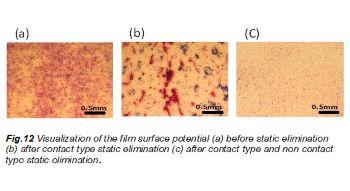
There has been increasing demand for digital printing using dry electrophotography especially to adapt high-resistance media such as transparent film or waterproof paper made from synthetic resin. In dry electrophotography, charging through the second transfer process causes electrostatic adhesion between each media for their high resistance, which lead to poor storage quality and electric shocks to operators. These prevent post-processing and limit the number of storable sheets. We have developed an elimination technology which improve these issues by utilizing the advantages of both a contact and a non-contact static elimination of static electricity. The contact static elimination is highly responsive to speed by supplying charge in narrow gap, and the non-contact is capable of uniform elimination of static electricity by supplying charge through corona discharge. This technology is installed as a paper output option for products of Fujifilm, Revoria Press PC1120, EC2100S/EC2100, SC285S/SC285. As a result of introducing the technology to the market, it was found that it is necessary to accommodate static elimination for various types of media. When evaluating media resistance for each region's media using the charge decay half-life as an indicator, no regional differences were observed among Western countries, Asia, and Japan. For representative high-resistance media such as films, hologram films, label paper, and water-resistant paper, it was found that static elimination is required when the surface resistivity exceeds a certain value. This technology improves the work of printers with high resistance materials such as film and waterproof paper, reduces the need for the previous work of peeling off stuck paper, avoids operators from large amounts of static electricity. So, this technology enables digital printing using dry electrophotography to handle a variety of media, enabling printing companies to add value and expand the market.
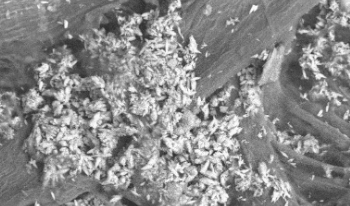
This study investigates the influence of paper lint adhesion on the frictional characteristics of rubber rollers used in multifunction printers (MFPs). Contamination of roller surfaces by fine paper particles after extensive operation is recognized as a major cause of paper-feeding failures, including paper jams. However, the mechanism by which such contaminants affect frictional behavior has not yet been fully elucidated. The objective of this work is to clarify the influence of paper lint adhesion on both friction and wear mechanisms. The study demonstrates that the frictional characteristics cannot be accurately predicted solely by the optical measurement of paper lint accumulation, primarily because particle refinement caused by frictional interaction alters the effective contact state. Consequently, a friction-based evaluation approach is proposed as a more reliable method for quantifying paper lint adhesion and its effect on roller performance.
Pump pulsation has long been a major issue affecting print quality in inkjet printers. Diaphragm pumps inherently generate pulsation, so users have traditionally installed external suppression mechanisms as a countermeasure. Recently, demand for recirculating printheads has increased, making pulsation suppression an even more critical challenge. KNF explored whether the pump itself could reduce pulsation without relying on the user. This led to the development of the FP series we are introducing.
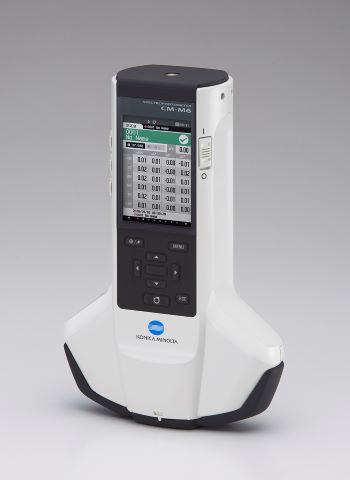
In terms of the value of print production in Japan, paper media is on the decline, while non-paper media is on the rise in nowadays, responding to the industrial printing has become an urgent matter for printing industry. Based on the recognition that printing is an industrial product, we will introduce our latest spectrophotometers with some examples to promote unified color management based on the CIE/ISO standard light D65 and to support Refined CMF Design* that have attracted attention in recent years. *An easy-to-understand way of referring to CMF (color, material, finish). In recent years, there has been a great deal of interest in CMF, including the use of recycled materials.
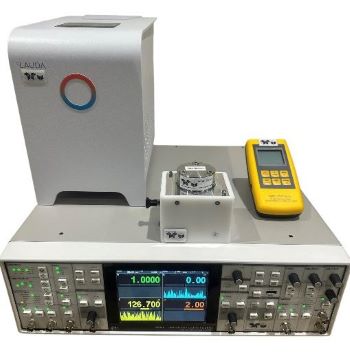
Inkjet printing involves the complex interaction of mechanical, acoustic, and fluidic phenomena operating on microsecond timescales and micrometre length scales. Within a printhead, inks experience pressure oscillations approaching 100 kHz and shear rates up to 10⁶ s⁻¹: these result from nanometre-scale deformations of the ink channel walls. These conditions impose viscoelastic stresses that are not captured by conventional rheometers, which are typically limited to oscillation frequencies below 100 Hz. Consequently, many inks that have apparently identical bulk rheology may exhibit very different jetting behaviours. The TriPAV High-Frequency Rheometer was developed to bridge this gap by characterising low-viscosity fluids under realistic inkjet operating conditions. TriPAV uses solid-state piezoelectric excitation to measure the linear viscoelastic properties (G’, G”, η*) of inks and functional fluids across frequencies from 1 Hz to 10 kHz—a frequency range much closer to those encountered during waveform actuation in Drop-on-Demand (DoD) and Continuous Inkjet (CIJ) systems. The instrument completes a full frequency sweep in under five minutes using <0.1 mL of sample and operates over 5–80 °C, enabling analysis of volatile or reactive inks, UV formulations, and solvent-based coatings. In its rapid step strain Printhead Mode, the TriPAV reproduces the acoustic excitation within a printhead channel. Controlled step-strain waveforms applied via a piezo actuator, and measured by a passive sensor, yield fluid response parameters—peak amplitude, peak time, and relaxation time—that correlate directly with waveform features such as drive voltage, pulse width, and wait time. Temperature-dependent tests (20–60 °C) further identify conditions that maximise pumping efficiency, meniscus stability, and droplet reliability.
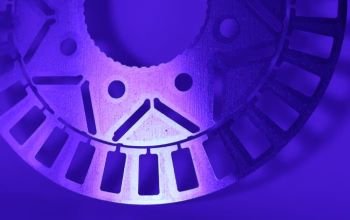
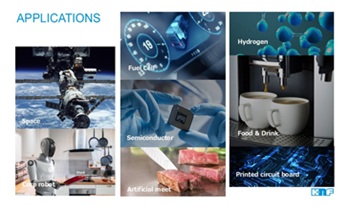
Many industrial processes require the deposition of materials with very specific functional and physical properties, often rendering them incompatible with established digital printing technologies. Ultra-High Viscosity Inkjet has demonstrated a dramatic improvement in productivity, precision, and material efficiency, enabling additive manufacturing in many of these processes. Quantica’s NovoJet™ printhead technology is being deployed in modular Print Engines that facilitate rapid adoption and integration into the production of fuel cells, electric motors, decorative products, and other high-volume, flexibly manufactured components.
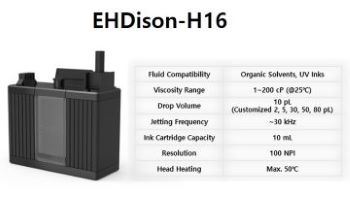
Inkjet printing is widely used due to its high precision in depositing ink at specific locations. However, it is limited to low-viscosity inks below 20 cP, restricting its compatibility with various functional materials. In contrast, electrohydrodynamic (EHD) printing allows jetting of inks with viscosities above 50 cP, but its short working distance (≤100 μm) and low throughput hinder large-scale application. To overcome these limitations, we have developed an innovative hybrid inkjet printhead that integrates the benefits of both conventional piezoelectric and EHD printing mechanisms. Utilizing this advanced system, we conducted experiments on the ejection of 200 cP viscosity inks, a feat challenging for conventional piezoelectric-actuated systems. The proposed hybrid inkjet printhead equipped with both piezoelectric actuators and EHD electrode to achieve a synergistic effect combining mechanical and electrical forces. The hybrid inkjet printhead enables stable ejection of high-viscosity inks (≤200cP) through 16 nozzles and 100 npi simultaneously. Also, this hybrid inkjet printhead can eject droplet volume range between 10 and 12 pL at a working distance exceeding 1 mm. Therefore, the ability to eject from multiple nozzles and high viscous ink concurrently enhances productivity, expanding the potential for applications across various industrial sectors.
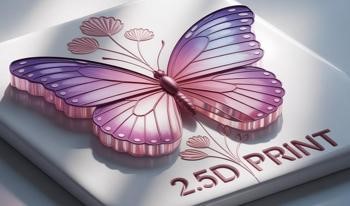
Artificial Intelligence (AI) is being incorporated into almost every field as it can make procedures efficient. The printing industry for material appearance reproduction might sometimes require considerable time to fabricate final products. One of the technologies for realistic and natural-looking material reproduction is called 2.5D printing. To reduce intermediate printing stages, thereby making them more eco-friendly, time-efficient, and cost-efficient, well-known AI tools can be explored in the 2.5D printing field. In this way, customers can be presented with the digital versions of their 2.5D prints before proceeding to the (final) printing. To our knowledge, this is the first study that explores the potential of AI tools with regard to 2.5D prints. We test some of the well-known commercial text-to-image generation AI tools. The study is preliminary in order to obtain some initial observations on potential of AI tools to be able to generate realistic and natural-looking 2.5D prints.
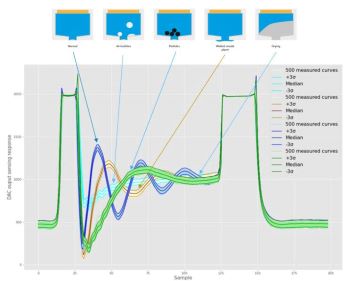
The idea of using the piezoelectric element of an inkjet printhead as an acoustic sensor for inferring the status of the jetting nozzles is almost as old as inkjet itself. While piezoelectric inkjet printing devices have evolved considerably since the early days of inkjet printing, enabling the continuous development of novel inks, functional fluids, substrates, pre- and post- printing treatments, and facilitating the adoption of new material deposition processes across many industries, nozzle acoustic sensing has seen minimal adoption by the industry. With a few notable exceptions, the inkjet community has been reticent to adopt this aspect of the inkjet technology. The main reasons argued for not embracing this technology are its perceived inability to identify subtle failure modes (deviated nozzles) and the difficulties of machine operators to interpret and react to this novel type of information. In this paper we will argue that developments in Artificial Intelligence can help overcome these limitations. Agentic AI and Reinforcement Learning provide a conceptual framework and a technology capable of improving nozzle failure classifiers and defining and evaluating multiple automatic responses of the printing system to changing printing conditions, enabling a quasi-real-time optimization of the printing process.