 Find this author on Google Scholar
 Find this author on PubMed
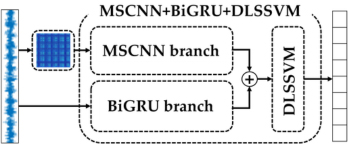
Traditional CNN-based bearing fault diagnosis methods are constrained by single-scale convolution kernels, which cannot extract multi-scale fault features, leading to low feature distinguishability, weak generalization ability, and poor noise resistance. To address these issues, this paper proposes a hybrid intelligent fault diagnosis framework named MSCNN–BiGRU–DLSSVM. The model adopts a multi-scale spatiotemporal fusion network for multi-scale spatiotemporal feature complementary learning: the first branch converts 1D vibration signals into 2D images via Markov transition field encoding and feeds them into a customized Multi-Scale Convolutional Neural Network (MSCNN) to extract multi-scale discriminative spatial fault features; the second branch takes raw temporal sequences as input and uses a Bidirectional Gated Recurrent Unit (BiGRU) to capture bidirectional multi-scale temporal dependencies of signals. The complementary multi-scale spatiotemporal features from the two branches are fused and fed into a Differentiable Least-Squares Support Vector Machine (DLSSVM) for fault classification. The DLSSVM achieves end-to-end joint optimization with the dual-branch backbone through reparameterization and differentiable loss design. Comprehensive validation on the public CWRU bearing dataset shows that the proposed framework provides a robust and practical approach for bearing fault diagnosis.
Huicui Xin, Lei Qiao, Zhimin Xu, Guanqun Wang, You Cui, Yang Yang, "Multi-Scale Spatiotemporal Fusion Network with Differentiable LSSVM for Robust Bearing Fault Diagnosis" in Journal of Imaging Science and Technology, 2026, pp 1 - 10, https://doi.org/10.2352/J.ImagingSci.Technol.2026.70.6.060403