Abstract
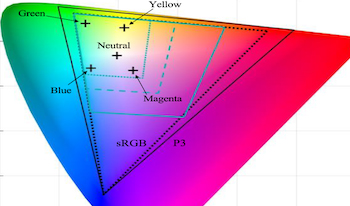
The color consistency between left and right eye images impacts users’ overall visual experience when viewing near-eye displays (NEDs). This has received insufficient attention in the literature. In this study, experiments were conducted to measure the binocular just-noticeable color difference (JNCD) from the CIE 1976 u′v′ chromaticity diagram. A custom binocular viewing apparatus, which contains no lenses, prisms, or mirrors, was developed to allow for accurate and reliable measurement of the binocular JNCD. Five color stimuli (neutral, magenta, green, blue, and yellow) at three luminance levels (100, 150, and 200 cd/m2) were adopted as the reference stimuli in a series of adjustment experiments. During these experiments, observers were required to determine the binocular JNCD across eight color-change directions under three background luminance conditions (0, 40, and 80 cd/m2). It was found that the binocular JNCD, as measured on the u′v′ diagram, was significantly influenced by the direction of color change and the luminance contrast between the stimulus and the background. Specified by the one-standard-deviation ellipse, the experimental data indicated that the binocular JNCD values correspond to 0.0024, 0.0044, 0.0043, 0.0040, and 0.0038 u′v′ units for neutral, magenta, green, blue, and yellow colors, respectively. These findings should contribute to a deeper understanding of binocular color perception and provide a useful reference for NED color calibration and industrial optical design.
 Find this author on Google Scholar
 Find this author on PubMed