Postdoctoral Workstation, Informedia Electronic Co., Ltd., Dalian 116001, China
Faculty of Medicine, Dalian University of Technology, Dalian 116024, China
 Find this author on Google Scholar
 Find this author on PubMed
Postdoctoral Workstation, Informedia Electronic Co., Ltd., Dalian 116001, China

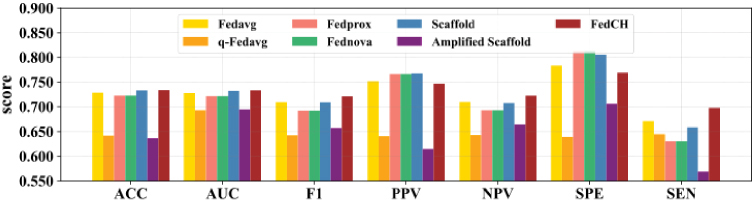
Cardiovascular disease (CVD) remains a major global health burden and the leading cause of mortality worldwide. Although machine learning has shown promise for CVD risk prediction, centralized training on sensitive medical data from multiple hospitals raises serious privacy and security concerns. To address this issue, we propose FedCH, a novel federated learning method for collaborative CVD prediction. Specifically, FedCH quantifies client heterogeneity by measuring the similarity between local and global models together with client-specific prediction accuracy. These metrics are used to dynamically weight the global aggregation process, thereby improving the overall model performance while promoting fairness across clients. In addition, by incorporating historical global model parameters into the update process, FedCH mitigates local model fluctuations and enhances the generalization and robustness of the global model. Comprehensive evaluations on four public datasets and a real-world cardiovascular dataset from a tertiary hospital in China show that FedCH consistently outperforms five state-of-the-art federated learning baselines under heterogeneous client settings.
Xiaolu Xu, Yulong Li, Shuai Zheng, Jia Shang, Chengjie Lu, Hongbin Lu, Yonggong Ren, Qiannan Zhang, "Fair and Robust Federated Learning for Cardiovascular Disease Prediction via Client Heterogeneity Quantification" in Journal of Imaging Science and Technology, 2026, pp 1 - 13, https://doi.org/10.2352/J.ImagingSci.Technol.2026.70.5.050507