 Find this author on Google Scholar
 Find this author on PubMed
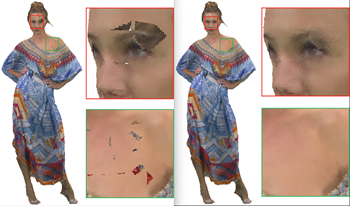
As an immersive imaging modality, point clouds (PCs) sustain compression distortions that degrade visual quality and impair the perceptual experience. To mitigate these distortions and enhance the visual quality of PCs, a synergistic 2D–3D fusion for distortion restoration in G-PCC Trisoup encoded PCs is proposed. To address the challenge of detecting multi-scale and irregularly shaped triangular hole distortions caused by G-PCC Trisoup encoding, which is difficult to perform directly in 3D, a residual-based detection method is proposed. Here, the 3D data is projected onto 2D to meet the detection requirements for triangular holes with varying distortion levels. Considering that screened Poisson surface reconstruction provides more accurate 3D reconstruction results and that estimating depth information of triangular hole regions solely through restoring 2D geometry projection maps may incur significant errors, a joint 2D and 3D geometry estimation method is proposed. This method utilizes the reconstructed 3D information to filter errors in the 2D restoration and combines 2D and 3D estimates by averaging, thereby achieving accurate geometry information estimation for triangular hole regions in PCs. Moreover, relying solely on the restoration of 2D texture projection maps to achieve 3D color correction leads to accuracy limitations; hence a joint 2D and 3D color estimation method is proposed to realize smooth color transitions between triangular hole regions and non-hole regions. Experimental results on multiple PC models from three different datasets demonstrate that the proposed method achieves superior performance in restoring both geometry and texture distortions of G-PCC Trisoup encoded PCs. Compared to the distorted inputs, the restored results exhibit an average improvement of 1.36 dB in both geometry and color quality.
Renwei Tu, Xilei Shen, Yongqiang Bai, Di Ge, Zhongjie Zhu, "Synergistic 2D–3D Fusion for Distortion Restoration in G-PCC Trisoup Encoded Point Clouds" in Journal of Imaging Science and Technology, 2026, pp 1 - 14, https://doi.org/10.2352/J.ImagingSci.Technol.2026.70.5.050502